The Sofa Styling Guide: How to Choose and Layer a Throw Blanket
There’s a reason the throw in the magazine photo looks effortless and yours looks like laundry. It isn’t the blanket — it’s three small decisions nobody mentions.
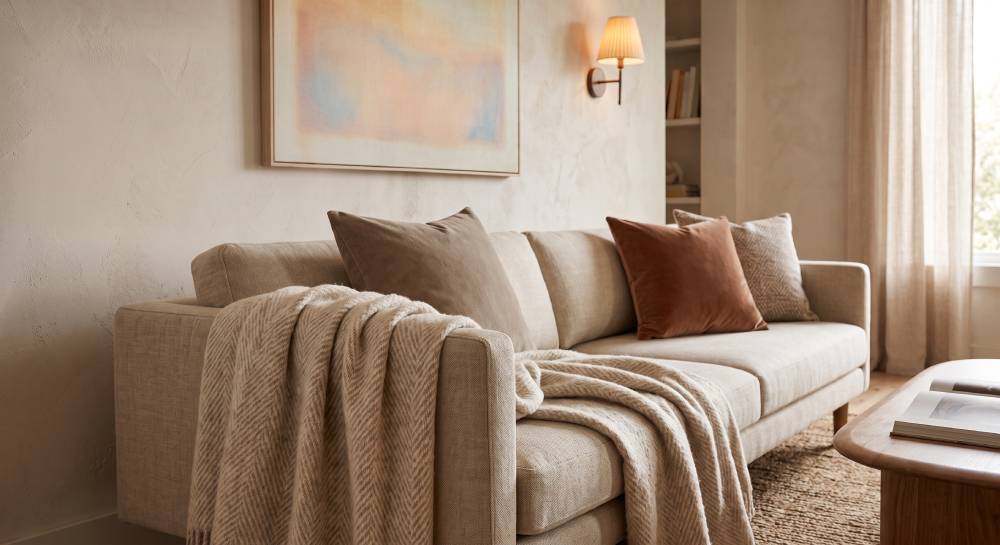
Buy a throw blanket, drape it over the sofa, step back. Somehow it looks less like the room you were picturing and more like something got left behind.
Almost everyone has done this. And the fix has very little to do with spending more.
It comes down to picking the right weight for how you’ll actually use it, choosing a texture that contrasts with what’s already there, and one folding decision that changes everything.
Start with the mistake most people make first.
Decide whether it’s for warmth or for looking at
This sounds obvious. It’s the thing people skip.
A throw bought purely as decoration can be anything — the loose knit, the pale cream, the delicate weave. It’s going to sit on the sofa arm and be admired.
A throw you’ll actually pull over yourself three nights a week needs to survive that. Which means darker, denser, machine washable, and not something that snags.
Buying the decorative one and then using it nightly is how you end up with a matted, marked blanket in eight months. Be honest about which you’re buying.
The practical test: if you’d feel a flicker of annoyance watching someone flop onto the sofa with it, you’ve bought a decorative throw. That’s fine — just buy a second, tougher one for actual use, and let the pretty one stay on the arm.
Match the material to the room’s temperature, not the season
Throws get sold on seasons. Rooms don’t work that way — a west-facing living room stays warm in November, and a north-facing one is chilly in June.
What matters is the weight, and the fabric decides it:
- Cotton and cotton-blend weaves — light, breathable, minimal warmth. Best for warm rooms or purely decorative use. They drape softly rather than holding shape.
- Flat fleece — the middle ground. Warm without bulk, cheap, machine washable, and it holds a fold well. The default for a reason.
- Sherpa and faux fur — genuinely warm. Deep pile traps far more air than flat fabric, so these are for cold rooms and winter evenings. Bulky to store, and too warm for a mild room.
- Chunky knits — the most decorative option, and the most structural. They hold shape beautifully when draped, but the open weave lets air through and snags on jewellery and claws.
If you want a number to compare with rather than adjectives, look for GSM — grams per square metre. Under 200 is thin, 250–350 is a comfortable middle weight, and 400+ is genuinely heavy. Most listings don’t publish it, and the ones that do are usually more confident about what they’re selling.
The rule that makes a throw look intentional
Here’s the one that changes the most for the least effort.
Contrast the texture, repeat the tone.
A smooth fleece throw on a smooth leather sofa disappears. The same throw in a chunky knit reads instantly, because your eye registers the difference in surface. Texture contrast is what makes a throw look like a deliberate layer rather than a spare blanket.
Meanwhile, keeping the colour close to what’s already in the room is what stops that contrast becoming a clash. A cream knit on a beige sofa works because the tones agree even though the surfaces don’t.
Which raises the question of colour more broadly — and there’s a simpler approach than most people assume.
Colour: pick one of three approaches
You don’t need a theory. You need to pick a lane.
- Tonal. A shade or two lighter or darker than the sofa. Quietest option, and the hardest to get wrong.
- Echo. Pull a colour that already exists in the room — from a rug, a cushion, a piece of art — and repeat it in the throw. This is what makes a room look pulled together rather than assembled.
- Anchor. One deliberately bolder piece in an otherwise neutral room. Rust, deep green, a print. High impact, but it only works if the rest of the room stays quiet.
One caution on the anchor approach: if your sofa is already patterned, skip it. Two competing patterns in the same visual space is the fastest route to a room that feels busy.
How to actually drape it
Now the part that takes thirty seconds and does more than the purchase itself.
The mistake is symmetry. A throw folded neatly and centred on the sofa back reads as staged, because nothing in a room people actually live in is that even.
Three approaches that work, depending on your sofa:
For a standard three-seater
Fold the throw lengthwise into thirds, then drape it over one arm — not both, not the middle. Let one end fall to the floor or close to it. The asymmetry is what sells it.
For a sectional or L-shape
Use the inside corner. Drape diagonally across the corner seat so the fabric breaks over both sections. It softens the hard angle that makes sectionals feel blocky.
For a two-seater or accent chair
Fold in half, then half again, and lay it across one back corner at roughly 45 degrees. Small furniture gets overwhelmed by a full drape, so less blanket showing is better.
Whichever you use, one detail matters more than the fold: let it fall unevenly. Tug one corner slightly longer than the other. Crumple the edge rather than smoothing it. Perfectly even edges are what make a throw look like it was placed by someone taking a photograph.
Two things worth checking before you buy
- Length. Most throws are 50×60″, and 60 inches leaves an adult covered to about the ankles. If you’ll actually nap under it, look for 50×70″.
- Colour on screen. Neutrals photograph badly — beige and ivory shift warmer or cooler depending on lighting and display. Check the customer photos, not just the product shots.
Get the weight right, contrast the texture, drape it unevenly. That’s most of it — and none of it costs anything beyond paying attention for a minute longer than usual.