Styled to Perfection: What to Put on a Coffee Table
There are only about four decisions involved, and one rule that matters more than all the styling advice put together: leave room to put a mug down.
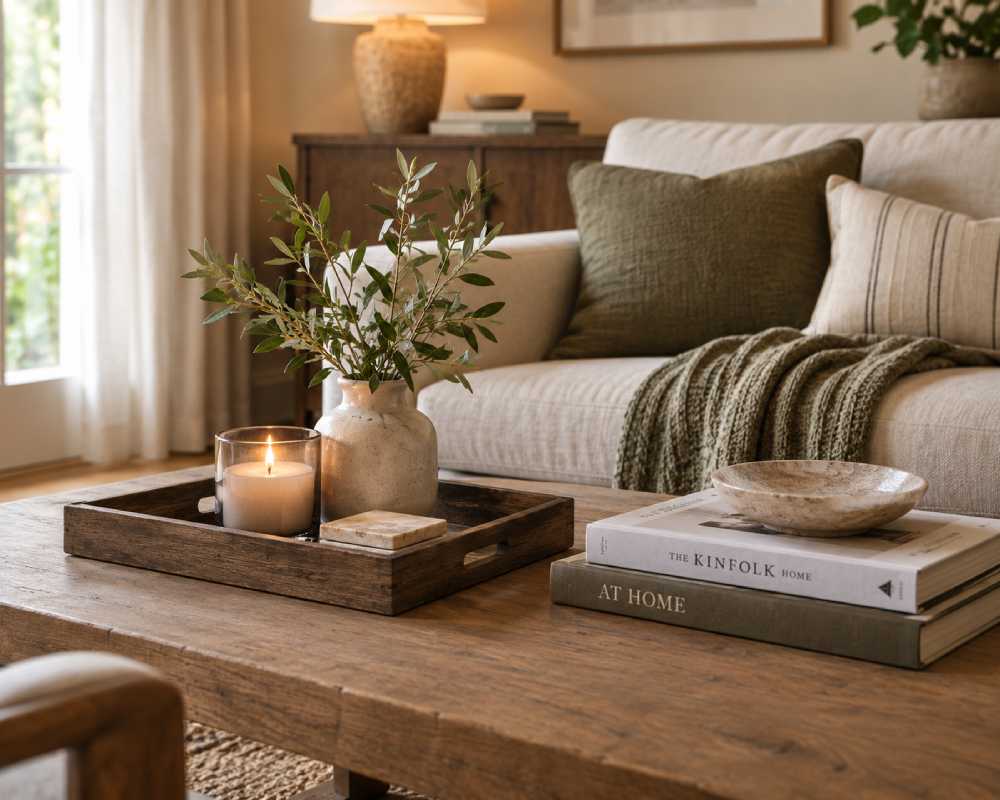
Coffee table styling has a failure mode that magazine photographs never show: the beautifully arranged table that nobody can actually use. Everything is composed, nothing can be moved without dismantling the arrangement, and dinner ends up balanced on a knee.
The fix is not less styling. It is knowing how much surface you are allowed to spend.
The rule that comes before the rules
Keep at least half the tabletop clear. Everything else in this article is subordinate to that.
It is easy to underestimate how quickly styling fills a table. A standard set of pieces, a 12 by 18 inch tray, a small stack of books and a six inch vase, occupies about 350 square inches. That sounds modest until you compare it with the table.
- A 28 inch round table has about 616 square inches. That set leaves 43 percent free.
- A 39 by 19 inch table has 741. It leaves 53 percent.
- A 40 by 22 inch table has 880. It leaves 60 percent.
- A 36 inch round has 1,018. It leaves 66 percent.
So on a small table, one conventional arrangement is already at the limit. On a large one you have room for a fourth element. Measure before you shop for accessories, not after.
The mug test: when the styling is done, sit on the sofa and put down a mug, a plate and a book without moving anything. If you cannot, remove one object.
Threes, and why odd numbers work
The oldest rule in decorating is that objects group better in odd numbers, and there is a reason beyond superstition.
A pair reads as symmetrical. Your eye finds the balance point, resolves it, and stops. Three objects cannot resolve that neatly, so the eye keeps travelling between them, which is what makes a group feel active rather than staged.
In practice, three groupings is the working number for most coffee tables:
- Something to contain: a tray, a bowl, a box.
- Something horizontal: stacked books, a folded throw, a flat object.
- Something vertical and alive: a vase, greenery, a candle.
On a large table you can run two clusters of three rather than one of six. On a small one, drop to two objects rather than crowding three.
Height layering, and the ceiling nobody mentions
Objects of the same height read as a row. Varied heights read as a composition. The usual advice is to work in three tiers:
- Low, 1 to 3 inches: trays, books, a shallow bowl.
- Mid, 5 to 8 inches: candles, a small sculpture, a compact vase.
- Tall, 10 to 16 inches: branches, a tall vase, a lamp on a large table.
Here is the part that gets left out: there is an upper limit, and it is set by sightlines.
Sit on the sofa and your eye is roughly 46 to 50 inches above the floor. An 18 inch coffee table carrying a 14 inch vase reaches 32 inches, which is comfortably below the line of sight across the room. Push that object past about 20 inches tall and the total starts intruding on the space between people sitting opposite each other, or between the sofa and the television.
Tall styling belongs on a console or a mantel, where nobody has to look through it.
The tray is the most useful object you can buy
A tray does three things at once, which is why decorators reach for it first.
It corrals: five small objects scattered across a table read as clutter, while the same five inside a defined edge read as one intentional group. It defines negative space, because the tray’s edge tells the eye where the arrangement stops and the usable surface begins. And it lifts off, so when you need the whole table for dinner or a board game, the styling leaves in one movement rather than twelve.
Size it to roughly a third of the tabletop. Bigger and it becomes the table; smaller and it stops reading as a zone.
What to actually put on it
Books. The reliable horizontal element. Two or three large-format books stacked flat give you a low platform to sit a smaller object on, which instantly creates a second height tier. Choose subjects you would genuinely open, since the alternative is decorating with objects you resent.
Something living, or convincingly not. Greenery is what stops a table looking like a display of hard objects. A small plant, a few cut stems, or good artificial branches all work. Real plants need light a coffee table often does not get, so a low-light species or a well-made faux stem is the practical choice.
Texture, deliberately varied. This is the difference between a styled table and a set of objects. If the table is wood, add something that is not: ceramic, glass, brass, woven fiber, stone. Three objects in three materials look considered; three in the same material look like a matching set.
A candle. Practical as well as decorative, since it is the one object on the table that changes the room when used. A lidded one is worth preferring, since it stays clean between uses and the lid keeps the fragrance from fading on an open shelf.
One personal object. A piece of pottery from a trip, an unusual box, something inherited. This is what stops the arrangement looking bought as a set, and it is usually the thing guests ask about.
Shape changes the arrangement
Rectangular tables have a long axis, and the arrangement should follow it. Work off center rather than dead center: a tray toward one end, a taller element at the other, and space between them. A single centered pile on a long table leaves two empty ends that read as unfinished.
Round tables want the opposite. There is no long axis, so a centered arrangement is the natural one, with height in the middle and lower pieces around it. Anything pushed to one side of a circle looks like it slid there.
Square tables take either approach, but a centered group with one element breaking the symmetry usually looks better than a perfectly balanced one.
The lower shelf is storage, not display
Two-tier tables invite you to style the bottom shelf as well. Resist a little.
The lower tier sits below eye level and is seen at an angle, so detail is largely wasted there. It is far more useful as the place where the things that would otherwise clutter the top actually live: remotes, magazines, a folded throw, a basket.
One practical note that depends on the table. Open shelves in slat, mesh or cane will not hold small items. Slat gaps are wide enough that keys and coins drop through, and objects with small feet sit unevenly across the grid. On those tables, use a basket or a box on the shelf rather than placing things directly.
Common mistakes
- Everything the same height. The most common one, and the easiest to fix by putting one object on top of the books.
- Symmetry. Matching objects at each end reads as a hotel lobby. Break it deliberately.
- Nothing you can move. If the arrangement collapses when one piece is lifted, it is a sculpture rather than a styled table.
- Too many small things. Five tiny objects read as mess; one larger object reads as intent. If you want the five, put them in a tray or a bowl.
- Styling for the photograph. The arrangement has to survive a Tuesday evening, not just a camera.
Keep it changeable
The best coffee table arrangements are not finished. Swapping the greenery with the season, changing the candle in winter, or rotating the books costs nothing and keeps the room from feeling static.
It also solves the practical problem. A table you are willing to rearrange is a table you are willing to clear, and a table you can clear is one you will actually use.
The short version
Leave half the surface free. Group in threes at three different heights, with nothing over about 20 inches tall. Put the small things in a tray so they lift off in one movement. Vary the materials, add one living thing and one personal thing, and keep the lower shelf for storage rather than display.