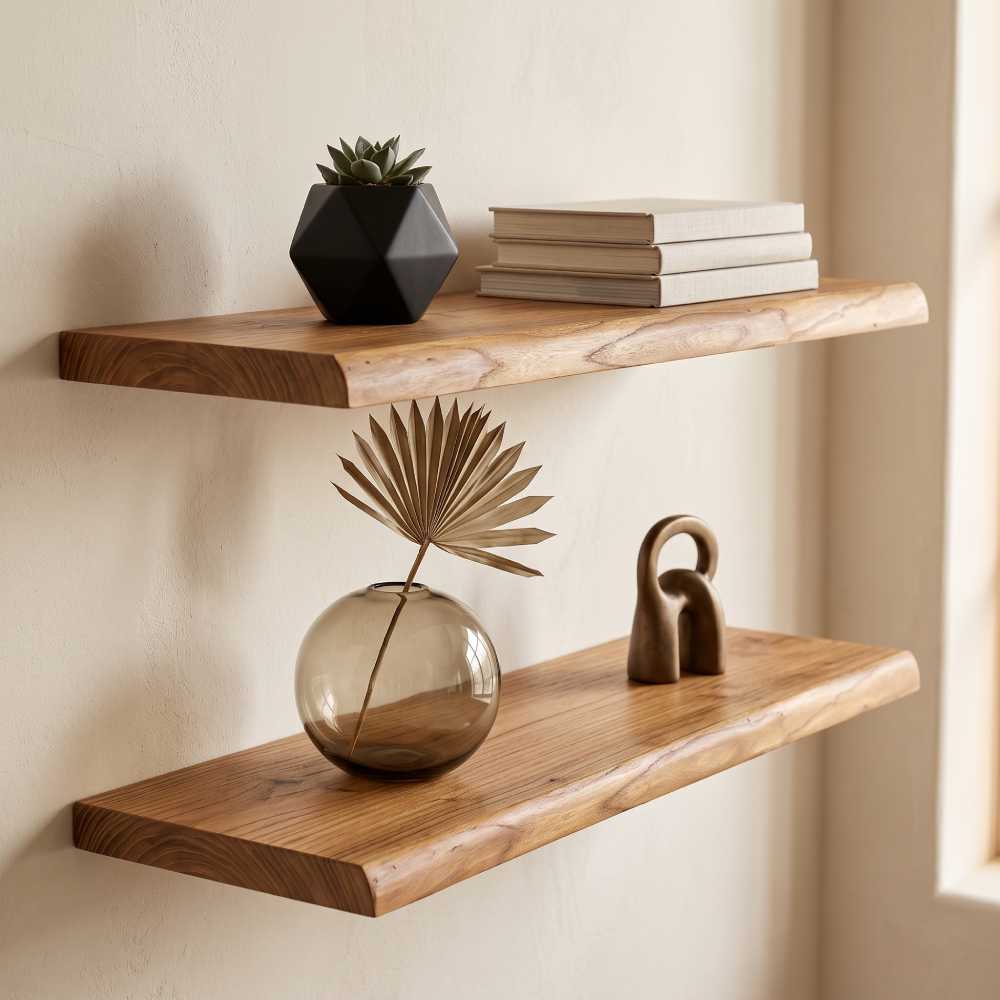
Image is for illustration purposes only. See the Amazon product page for actual photos.
Live Edge Floating Shelves 24 Inch, Solid Elm Set of 2
What we like
Hardwood does what softwood cannot: full depth and full capacity on a thinner board.
Worth knowing
A live edge means the two shelves will not match each other. That is the point.
Price and availability change on Amazon, always confirm before buying.
Why we picked it
A live edge is the one shelf feature you cannot fake, and it is the first we have covered.
Most timber is sawn square on all four sides. A live edge keeps the natural outer contour of the tree, with the bark removed but the shape left as it grew, so the front of the shelf undulates rather than running dead straight.
That has an immediate consequence worth understanding before you buy. The two shelves in this set will not match each other, because no two boards taken from a tree have the same edge. If you want a pair that reads as identical, this is the wrong product. If you want each shelf to look like a specific piece of wood rather than a manufactured component, it is exactly right.
It also means a printed or wrapped finish cannot imitate it. A laminate can copy grain convincingly at a distance, but it cannot copy a shape that varies along its length.
The more interesting story is what elm buys structurally, and it takes a direct comparison to see it.
We have covered one other solid timber shelf, also 24 inches long and also rated at 50 pounds. That one is solid pine at 1.75 inches thick and 6.5 inches deep. This is solid elm at 1.4 inches thick and 9.3 inches deep.
So this shelf is 43 percent deeper on a board 20 percent thinner, and still matches the capacity. Both of those work against it: depth increases the leverage on the brackets, and thinness reduces stiffness sharply, since a board’s resistance to bending rises with the cube of its thickness.
Loaded to 50 pounds, this shelf puts roughly 19 pound-feet of turning force on its fixings against about 13.5 for the pine one. It is carrying more, further out, on less material.
That difference is the hardwood. Elm is considerably harder and stiffer than pine, with an interlocking grain structure that makes it notably resistant to splitting, which is why it was traditionally used for chair seats and wheel hubs where wood has to take stress from several directions at once.
Practically, elm also dents far less readily than pine. A softwood shelf marks when something is set down sharply on it; a hardwood one mostly does not.
The 9.3 inch depth is the joint deepest we have covered, and the listing makes a fair point about why that matters: a large art book, a wide canister or a decent planter overhangs a standard 7 or 8 inch shelf. At 9.3 inches those sit fully supported.
Given the leverage that depth creates, this is a shelf to mount into studs rather than relying on drywall anchors. The listing says the hardware suits drywall, brick and studs, but with 19 pound-feet at full load, timber is where you want the screws.
Two details worth crediting. The steel brackets are described with reinforced welds all round, which matters because a bracket weld is the single point where a floating shelf fails catastrophically rather than gradually.
And the finish is water-based rather than solvent-based. That is why the listing can describe it as odor-free and suitable for a nursery or a food-prep area, since water-based finishes cure without the lingering solvent smell that oil-based ones can carry for weeks.
The elm is also FSC certified, so the timber is traceable to an audited source rather than simply described as sustainable.
What’s in the box
| Quantity | 2 shelves |
| Size each | 24 inches long by 9.3 deep by 1.4 thick |
| Material | Solid elm, FSC certified, live edge front |
| Finish | Water based, odor free once cured |
| Brackets | Steel with reinforced welds, hardware included |
| Capacity | 50 pounds per shelf |
| Load on fixings | Around 19 pound feet at rated load, so mount into studs |
| Note | Each shelf has a different edge profile; the pair will not match |
The honest take
What we like
- A live edge is the one feature a printed finish cannot imitate
- Solid elm, a hardwood, rather than softwood or board
- 43 percent deeper than the comparable pine shelf at the same capacity
- Elm dents far less readily than pine
- Reinforced bracket welds, which is where floating shelves fail badly
- Water based finish, so no lingering solvent odor
Worth knowing
- The two shelves will not match each other, by design
- Around 19 pound feet at full load, the highest here, so use studs
- 1.4 inches is thinner than the comparable solid wood shelf
- A live edge front is harder to line up neatly against a corner
- Real timber will move slightly with humidity over time
The edge the tree made
Check current pricing and availability for these Realgulf Live Edge Shelves on Amazon.
Check Price on AmazonPurchases made through this link support Homeander at no extra cost to you.