Bedroom Rug Ideas: Where Your Feet Land Is the Whole Point
A living room rug has to survive traffic. A bedroom rug has one job, and it happens in the four seconds after you wake up.
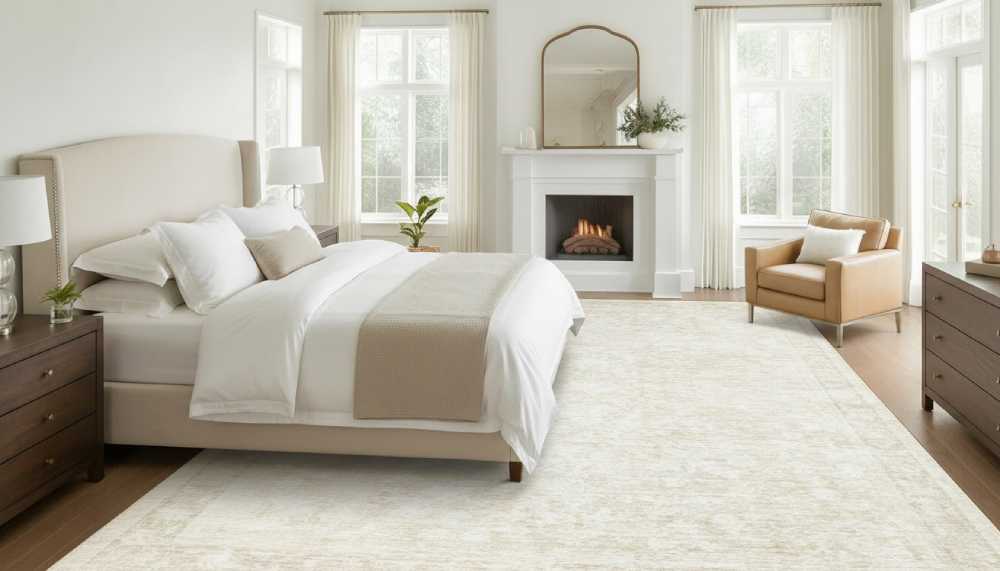
Bedroom rugs get chosen the same way living room rugs do, and that’s the mistake. The two rooms want opposite things.
A living room rug is walked across constantly, so durability wins. A bedroom rug is mostly stood on twice a day, at the moment your bare feet hit the floor. Comfort wins, and almost everything else follows from that.
Which changes the placement rules entirely, because the anchor is a bed rather than a seating group.
Three placements, and when each works
Large rug, two thirds under the bed
The standard approach, and the best one if the room allows. The rug starts partway down the bed, roughly at the foot of the nightstands, and extends past the end.
The key measurement is the margin: you want at least 18 to 24 inches of rug showing on each side, and about the same past the foot. That’s what guarantees your feet land on rug whichever side you get out.
Sizes that usually work: a queen bed wants an 8 by 10, a king wants a 9 by 12. Anything smaller and the margins disappear.
Runners on both sides
The workaround when a large rug won’t fit or won’t fit the budget. Two runners, one along each side of the bed, positioned so they catch your feet.
It costs considerably less and it delivers the actual function. What it loses is the anchoring effect, since the bed no longer sits on a defined surface. In a small room where the bed nearly spans the wall, this is often the more sensible choice anyway.
Small rug at the foot
A rug across the end of the bed only. This is decorative rather than functional, since your feet never touch it on waking.
It works in a room with an existing carpet where you want texture rather than warmth. As the only rug on a bare floor, it misses the point.
The test that settles it: sit on the edge of your bed and put your feet down. Wherever they land is where the rug needs to be. Every placement rule is a longer way of saying that.
Pile height, and why bedrooms flip the calculation
In a living room, low pile usually wins. It survives traffic, cleans easily, and furniture doesn’t sink into it.
A bedroom reverses most of that. Traffic is minimal, spills are rare, and nothing heavy moves across it. Which means the reasons to choose low pile mostly don’t apply here, and the reason to choose high pile, that it feels significantly better underfoot, applies more than anywhere else in the house.
So the honest guidance:
- High pile or shag is the natural bedroom choice. Deep, soft, warm on a cold morning. The trade is that it can’t be machine washed and traps dust deeper.
- Wool is the premium option. Naturally warm, resilient, and it recovers from bed leg compression better than synthetics.
- Low pile still makes sense in one situation: allergies. Deep pile holds dust and dander that vacuuming can’t fully reach, and a washable low pile rug can be laundered properly.
That allergy point is the real trade-off. Everyone else should probably go thicker in a bedroom than they would elsewhere.
What a rug does for a bedroom’s sound
This is the benefit nobody shops for and everyone notices.
Hard floors reflect sound. In a bedroom that means footsteps, doors, and noise from elsewhere in the house all bouncing around a room you’re trying to sleep in. Soft surfaces absorb rather than reflect, and a rug is usually the largest soft surface you can add to a floor.
Two things determine how much it helps: area and thickness. A large plush rug does meaningfully more than a small thin one. If your bedroom feels echoey or you can hear every footstep from the room above, going bigger and deeper is the fix.
It works both ways, too. If you’re the one on an upper floor, a thick rug reduces what the room below hears.
Colour, for a room you see in low light
Bedrooms are unusual in that you spend most of your waking time in them at the edges of the day, in lamplight or early morning grey rather than full sun.
That favours deeper, warmer tones. Charcoal, warm brown, deep green and terracotta read as enveloping under lamplight, where a bright white or cool grey can look stark. Pale rugs that photograph beautifully in daylight often feel colder than expected at 10pm.
Practicality points the same direction, which is convenient. A bedroom rug sits where shoes come off, moisturiser gets applied, and drinks occasionally spill on a bedside. Mid to deep tones hide all of that better than cream does.
If the room is small, matching the rug closely to the floor or wall tone keeps the space reading as one continuous surface rather than chopped into sections.
Under the bed, and what happens there
One practical note that applies to any rug under a bed frame.
Bed legs concentrate a lot of weight on a very small area, and they will leave dents. On low pile, those recover reasonably. On high pile, they can be permanent, so if you ever move the bed, expect to see where it was.
Two things reduce it: furniture coasters under each leg spread the load, and rotating the rug when you change the layout gives compressed fibres a chance to recover.
It’s not a reason to avoid a plush rug in a bedroom. It’s a reason not to expect one to look untouched when you rearrange.
The short version
- Sit on the bed and put your feet down. That’s where the rug goes
- Two thirds under the bed, with 18 to 24 inches showing each side
- Queen wants 8 by 10, king wants 9 by 12
- Go thicker than you would elsewhere, unless allergies say otherwise
- Deeper colours, because you’ll mostly see this room in low light
Get the placement right and even a modest rug does its job. Get it wrong and the most expensive rug in the house still leaves you stepping onto a cold floor.