Curtain Ideas That Make a Living Room Look Taller
Most curtains are hung in the wrong place. Move the rod and the same window, the same fabric, and the same room can look a foot taller.
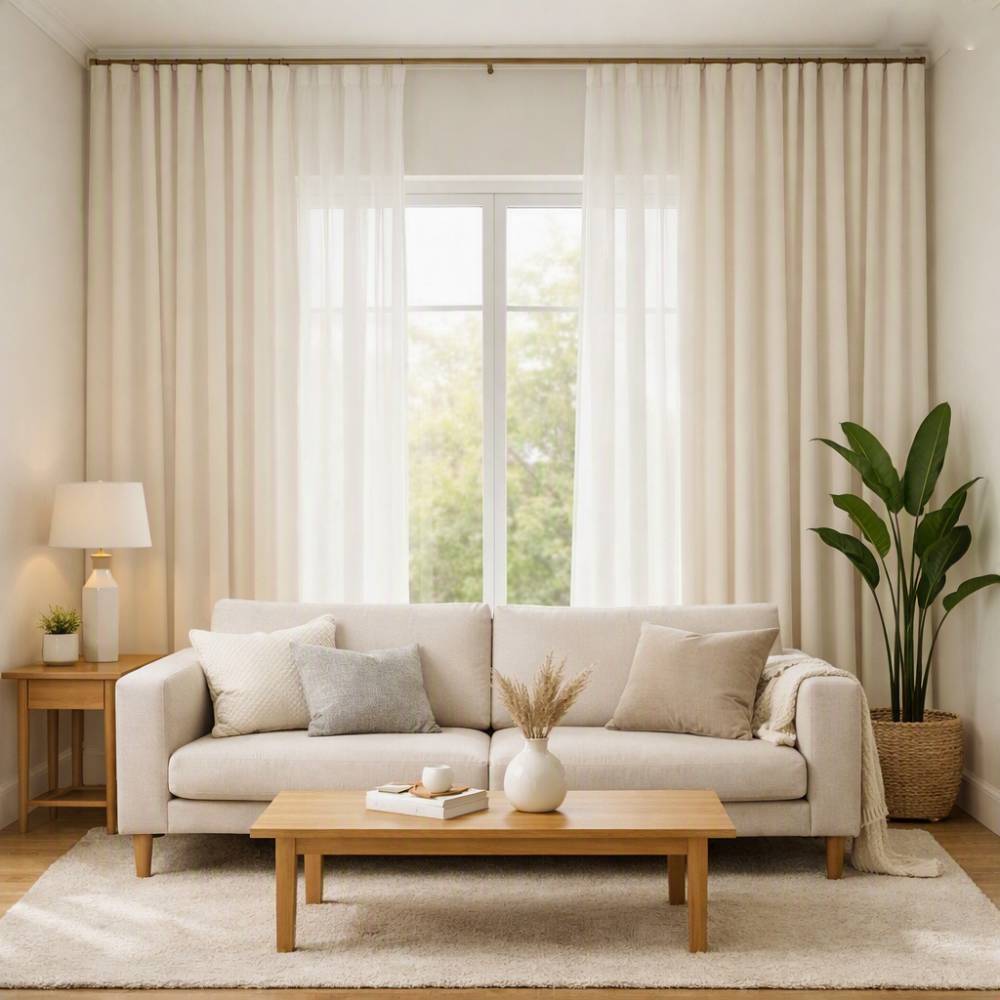
Here’s a quick test. Look at where your curtain rod sits.
If it’s a few inches above the window frame and roughly the same width, you’ve hung it the way most people do — and the way that makes a room look shorter than it is.
The fix costs nothing but a drill and twenty minutes.
1. Hang high and wide
This is the single highest-impact change you can make to a window, and it has nothing to do with fabric.
High: mount the rod 4 to 6 inches below the ceiling, not just above the window frame. Your eye follows the vertical line of the fabric from rod to floor, and reads that entire distance as the room’s height. Hang low and you cut that line short.
In a room with standard 8-foot ceilings, this alone can make the walls feel close to a foot taller.
Wide: extend the rod 8 to 12 inches beyond the window frame on each side. This lets the open curtains stack against the wall rather than covering the glass — so you get more daylight, and the window itself reads as wider than it is.
The rule of thumb: if you can see the curtain covering glass when it’s fully open, your rod is too short. All the fabric should sit on wall when the curtains are drawn back.
One consequence to plan for: hanging high means you need longer panels. Measure from the rod to the floor, not from the window. This is where most people get caught out — and it leads directly to the next mistake.
2. Get the length right, and commit to it
Curtains that stop short of the floor look unfinished in a way that’s hard to unsee once you notice it. There are three defensible lengths and one that isn’t.
- Just kissing the floor — hem sits within half an inch of the ground. Cleanest look, easiest to vacuum around. The safe default.
- Breaking — 1 to 2 inches of fabric resting on the floor, gathering slightly. Softer and more relaxed. Suits heavier fabrics.
- Puddling — 6 or more inches pooling on the floor. Deliberately dramatic, and genuinely impractical: it collects dust and needs rearranging after anyone walks past.
- Floating — hem hovering several inches above the floor. This is the one to avoid. It reads as a mistake rather than a choice.
The exception is a window above a radiator, a window seat or a built-in — there, a sill-length curtain is a sensible functional decision, not a compromise.
3. Layer sheers with blackouts
Now the technique that solves a problem most rooms have but few people name.
A living room needs two completely different things from a window at different times: soft filtered daylight during the day with some privacy, and total darkness for films or early evenings in summer. No single panel does both.
Layering does. Sheers on an inner rod, blackout panels on an outer one. During the day you close the sheers — light comes through diffused and softened, but people can’t see in clearly. At night you draw the blackouts across.
Two practical notes if you try this. Use a double rod bracket rather than two separate rods, or the spacing will look accidental. And keep the sheers a shade lighter than the blackout panels — sheers in a darker tone read as dingy rather than airy.
It’s more hardware and more fabric, which is the honest cost. But it’s the arrangement that makes a living room work at 2pm and 9pm equally well.
4. Choose the fabric for what the room lacks
Different fabrics solve different problems, and it’s worth naming which problem you actually have.
- Room feels dark? Light-diffusing linen or linen-look fabric in a pale tone. It scatters incoming daylight rather than blocking it, so a north-facing room feels brighter than bare glass would suggest.
- Room feels cold? Dense thermal fabric. Windows are the largest source of heat loss in most rooms, and a heavy panel noticeably reduces the chill radiating off the glass in winter.
- Room feels flat? Texture over pattern. A slubby weave or a subtle geometric adds interest at a distance without committing the room to a style the way a bold print does.
- Room feels small? Match the curtain colour closely to the wall. Contrasting curtains chop the wall into segments; matching ones let it read as one continuous surface.
That last one is counterintuitive enough that it’s worth repeating: in a small room, curtains that blend into the wall make the space feel larger than curtains that stand out against it.
5. Buy more width than feels necessary
The most common reason curtains look cheap has nothing to do with what you paid for them.
It’s fullness. A curtain stretched flat across a window looks like a bedsheet, no matter how good the fabric. You want 1.5 to 2 times your window width in total panel width — so a 60-inch window needs 90 to 120 inches of curtain across both panels.
Since most panels are sold at 42 to 52 inches wide, that often means buying two pairs rather than one for a wide window. It’s the least glamorous line item in the whole project and the one that most determines whether the result looks intentional.
The short version
- Rod height: 4–6″ below the ceiling, not just above the frame
- Rod width: 8–12″ past the frame on each side
- Length: measure rod to floor; kissing or breaking, never floating
- Fullness: 1.5–2× the window width in total panel width
- Layering: sheers inside, blackout outside, on a double bracket
Do the first two and you’ll notice the difference from the doorway. The rest is refinement.