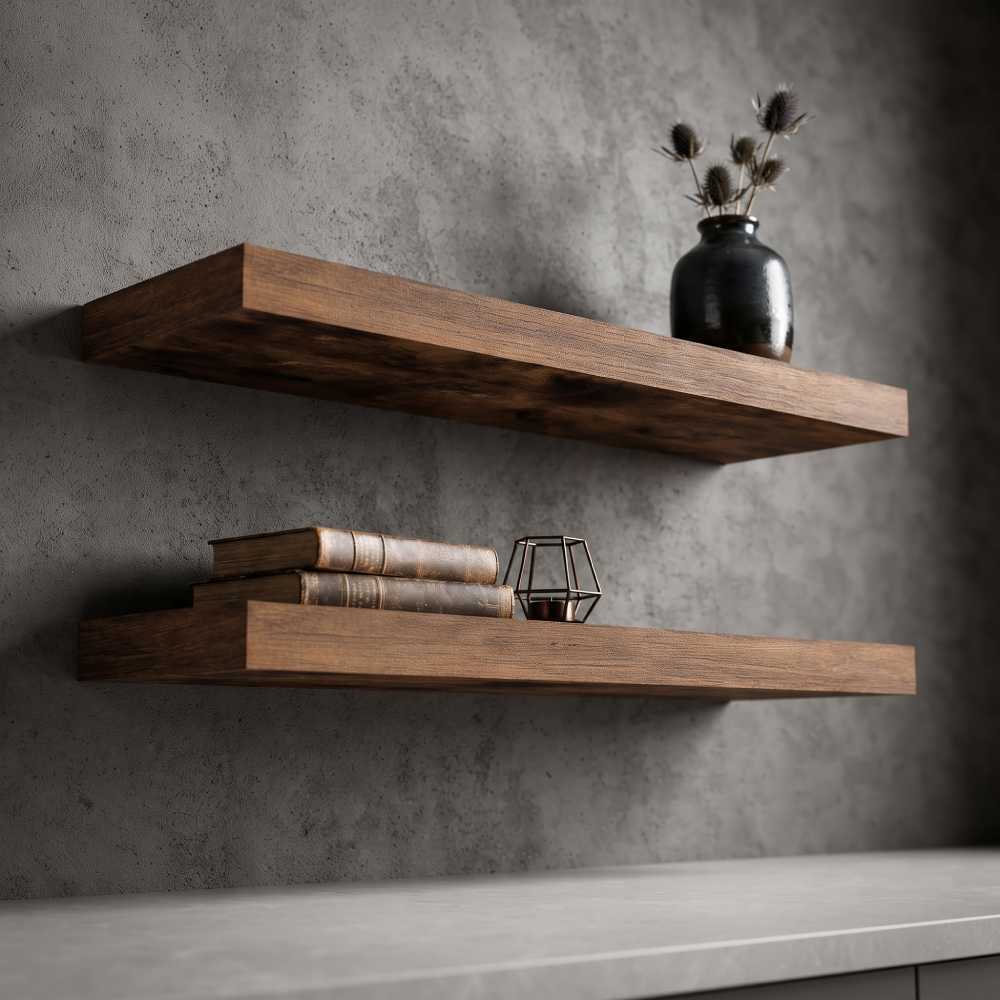
Image is for illustration purposes only. See the Amazon product page for actual photos.
Floating Shelves 15.7 Inch, Dual Pipe Bracket Set of 2
What we like
Two anchor types supplied, and the listing tells you when not to install at all.
Worth knowing
The deepest shelf here, and depth is what costs it capacity.
Price and availability change on Amazon, always confirm before buying.
Why we picked it
At 7.9 inches this is the deepest floating shelf we have covered, and depth is the specification people misread most.
More depth sounds like more shelf, and in terms of what fits on it, it is. But on a floating shelf depth is also what limits how much weight you can put there, because the load sits further from the wall and the bracket has to resist a longer lever.
The arithmetic makes it clear. Weight centered on a 7.9 inch shelf sits about 4 inches from the wall. At the rated 22 pounds, that produces roughly the same turning force on the bracket as a shallower 6.7 inch shelf carrying its rated 25 pounds. Almost identical load on the fixings, achieved with different numbers.
So the lower capacity here is not a weaker shelf. It is the same bracket strength expressed across a longer reach, and it is why comparing shelves on pounds alone is misleading unless you look at depth at the same time.
The practical version: if you want to store deeper objects, this is the shelf. If you want to store heavy ones, a shallower shelf will carry more.
The dual-pipe bracket is the second point of difference. Most concealed brackets use a single flat blade or a single rod that slides into the shelf body. Two parallel rods do something a single one cannot: they resist twist.
A single-rod bracket lets the shelf rotate slightly around that rod if weight is loaded unevenly, say a stack of books at one end. Two rods spaced apart lock that rotation, so an unevenly loaded shelf stays level rather than tipping toward the heavy end.
Now the thing this listing does that no other shelf we have covered does: it addresses different wall constructions properly.
Two types of expansion tube are supplied, one for solid walls like concrete and one for hollow construction. That distinction matters, because an anchor designed to expand against solid masonry behaves quite differently in a cavity, and using the wrong one is a common reason shelves pull out.
More striking is the instruction that follows. For hollow walls the listing says to secure screws into studs, and then adds: avoid installation if that is not possible.
That is an unusually honest sentence for a product listing. Most manufacturers would rather sell the shelf and let you work it out. Telling a customer not to install their product in certain conditions is the opposite of a sales pitch, and it is the single most useful line in the whole listing.
On material, the finish type is given as particleboard. That is the weaker of the common engineered boards, using larger chips than MDF and offering less holding strength around fixings. Here that matters less than it would on a cabinet, because the load is carried by iron brackets running inside the shelf rather than by screws into the board itself.
The 1.5 inch thickness is enough to conceal the bracket while keeping the profile slim. Expect the rustic brown finish to be a printed wood-look surface rather than real grain, which suits the retro styling but will not have the depth of solid timber.
The 15.7 inch length is worth noting against wall studs. US studs typically sit at 16 inch centers, so a shelf this length can reliably reach only one stud. That is fine at 22 pounds, but it is another reason the capacity is what it is.
The listing also suggests arranging the pair in staggered or ladder patterns rather than simply stacking them, which is genuinely how a set of two looks best on a wall.
What’s in the box
| Quantity | 2 shelves |
| Size each | 15.7 inches long by 7.9 deep by 1.5 thick |
| Bracket | Concealed dual pipe iron |
| Capacity | 22 pounds per shelf |
| Board | Particleboard with a rustic brown finish |
| Anchors | Two expansion tube types, for solid and hollow walls |
| Wall guidance | Hit studs on hollow walls; the listing advises against installing if you cannot |
| Stud reach | 15.7 inches reaches one stud on 16 inch centers |
The honest take
What we like
- Deepest shelf we have covered, so larger objects actually fit
- Dual pipe bracket resists the twist a single rod allows
- Two anchor types supplied for solid and hollow walls
- Tells you not to install where studs cannot be reached, which is rare candor
- Iron brackets carry the load rather than screws into the board
- 1.5 inch profile stays slim while concealing the bracket
Worth knowing
- 22 pounds is the lowest capacity of the shelves we have covered
- Extra depth is what costs it that capacity
- Particleboard is the weaker engineered board around fixings
- The finish is a printed wood look rather than real grain
- 15.7 inches reaches only one stud on standard 16 inch centers
Depth, and what it costs
Check current pricing and availability for these HOOBRO Floating Shelves on Amazon.
Check Price on AmazonPurchases made through this link support Homeander at no extra cost to you.