Reflecting Style: How to Choose Decorative Mirrors for Every Room
A mirror is the only thing you can hang that gives a room more light than it had before. Get the shape, the scale and the position right and it does the work of a window.
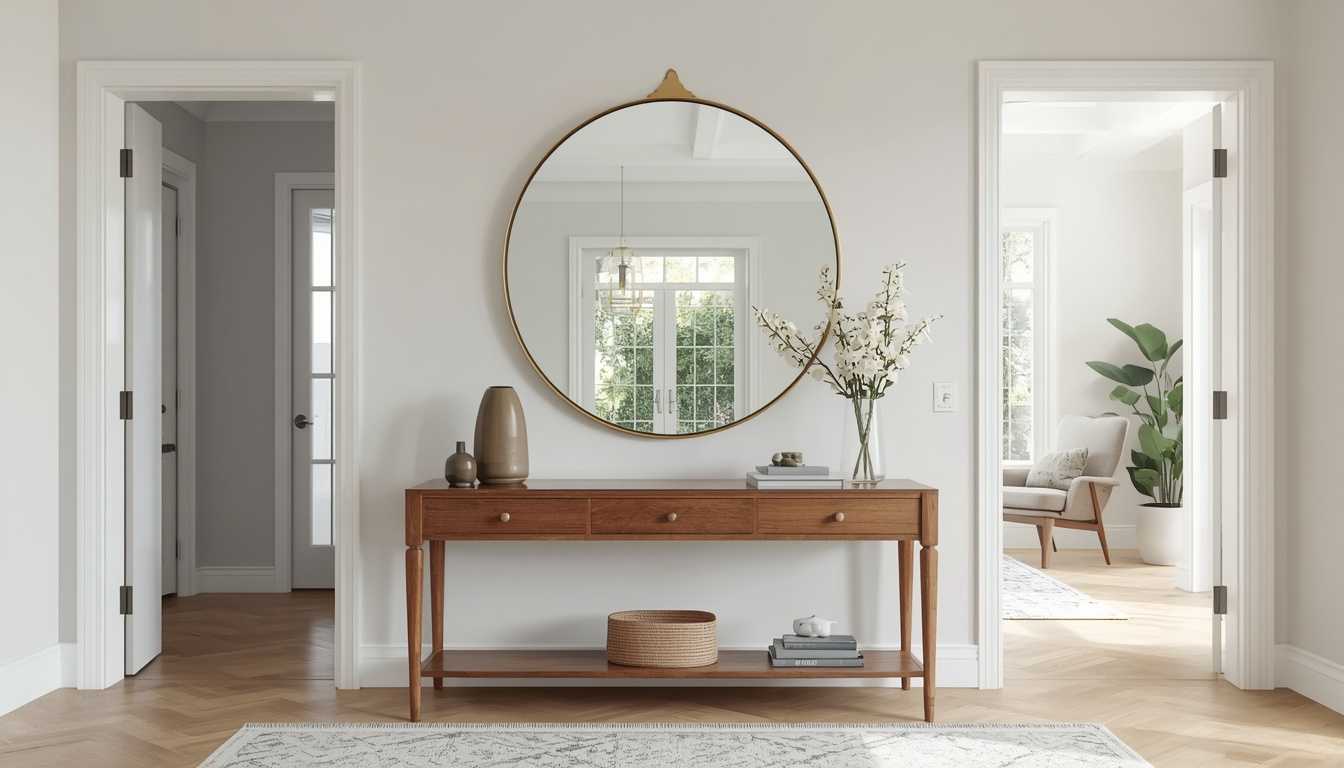
Every other thing you hang on a wall is subtractive. A canvas covers a patch of paint. A shelf takes up space. A mirror is the one exception: it gives back whatever is in front of it, which means it can add light, depth and view to a room that had none of those to spare.
That is why mirrors get recommended for small rooms so reflexively. The advice is right, but it is usually given without the part that makes it work, which is that a mirror only amplifies what it faces. Hang one opposite a blank wall and you have doubled the blank wall.
Start with what it will reflect, not where it will fit
Before choosing a size or a shape, stand where the mirror will go and look back at what sits opposite. That reflection is what you are buying.
The best thing to face is a window. A mirror opposite or adjacent to a window catches daylight and throws it back into the room, which genuinely brightens a dim space rather than just appearing to. It also doubles the view, so a small window reads as two.
Next best is depth: a doorway through to another room, a long hallway, a staircase. Reflecting an opening makes a room feel like it continues, which is the effect people are actually after when they say a mirror makes a space feel bigger.
What to avoid is reflecting clutter, a television, or the underside of a ceiling light that will glare. And in a bedroom, think about what the mirror shows from the bed, since a large mirror facing the bed unsettles some people and there is no design argument worth losing sleep over.
The thirty-second test: hold your phone up where the mirror will hang, camera facing out, and look at the screen. That is roughly what you will see every day.
Silhouettes, and what each one is for
Shape is the decision people agonise over and it is more practical than it looks. Each outline does something specific.
The arch. An arch is architectural rather than decorative, echoing doorways and windows rather than ornament. That makes it the most versatile shaped mirror: it reads as classic in a period house and modern in a new one, and it adds a curve to a room of straight lines without becoming the loudest thing in it. Above a mantel or a vanity, it is the safe shaped choice.
The scalloped or fluted arch. The same form with decoration added. This is a statement rather than a background piece, and it works best in a restrained room. In a space that already has patterned tile, bold wallpaper or a strong vanity, a scalloped outline competes where a plain arch would sit quietly.
Organic and asymmetric shapes. Irregular outlines have no top, no alignment and no symmetry to get right, which is either liberating or difficult depending on the wall. They suit gallery arrangements and entryways where the mirror is decoration first. Look for one with multiple hanging points, since an asymmetric shape changes completely depending on which edge you put upward.
The circle. Interiors are overwhelmingly rectangular. A circle has no corners competing with the room’s straight lines and no orientation to decide, which is why round mirrors settle into busy walls that a rectangle would make busier. They are also the most forgiving above a console.
Open and sculptural frames. Wire and geometric frames let the wall show through, so the paint colour becomes part of the piece and the frame casts its own shadow patterns in raking light. Worth knowing that on these the mirror is often much smaller than the overall diameter, so read the two measurements separately.
Natural woven textures. Rattan, jute and rope frames bring softness that metal cannot, and they read warm in rooms full of hard surfaces. They belong in dry rooms, since natural fibre absorbs moisture.
The floor leaner. An oversized mirror propped against the wall does something no hung mirror can: it reflects the floor, which reads as the room continuing rather than a picture of it. Anchor it properly, since a large leaning mirror is a genuine hazard with children or pets around.
Scale: the rule that prevents most mistakes
Mirrors are bought too small far more often than too large. The working guide is the same one that governs artwork.
- Above furniture, aim for roughly two thirds to three quarters of the furniture’s width. A 36 inch console wants a 24 to 27 inch mirror; a 60 inch sideboard wants 40 to 45 inches.
- Above a single vanity, the same rule applies. A standard 32 to 36 inch vanity suits a 24 inch round or a 24 by 36 inch rectangle.
- Above a double vanity, either one wide mirror or two matching ones. If you choose two, buy them as a set rather than ordering the same mirror twice, because separate production runs of a powder-coated finish can differ visibly side by side.
- On a blank wall, go larger than feels comfortable. A mirror that is slightly too big reads as intentional; one that is slightly too small reads as an accident.
Round mirrors are the least forgiving here, because there is no long dimension to absorb an error. A circle that is two inches off looks wrong in a way a rectangle does not.
For height, the usual guidance of centring artwork at eye level, around 57 to 60 inches from the floor, holds for mirrors too. Above a vanity or console, leave 6 to 10 inches between the furniture top and the mirror’s bottom edge.
Frame finishes, and where each belongs
The finish decision is partly aesthetic and partly a question of which room the mirror is going into. Humidity is what separates them.
- Aluminium and stainless steel do not rust at all. That is a property of the metal rather than a coating that can scratch through, which makes them the right choice for any bathroom taking daily showers.
- Solid wood is warm, ages beautifully and shows real grain that shifts as you move past it. It belongs in dry rooms. In a steamy bathroom it swells, and shaped wooden frames fail sooner because they have more joints.
- Wood-effect on MDF or PS gives the look at lower cost and lower weight, though it cannot be refinished and dents rather than marks.
- Matte black reads graphic and modern, and shows dust and water spots more than brushed finishes.
- Warm brass and gold read softer. On a slim frame around an organic shape, gold reads as a drawn line rather than a border, which is why it suits irregular outlines particularly well.
The specifications worth checking
Mirror listings vary enormously in how much they tell you, and a few terms are worth knowing because they get used loosely.
Float glass versus high definition. Float glass is formed on molten tin, which produces genuine flatness, and flatness is what determines whether a reflection is accurate or subtly warped. Reflection doubles any error, so a slight wave in the glass becomes a visible distortion in your face. “High definition” is a marketing phrase and guarantees nothing. If a listing specifies float, that is worth more than a paragraph of adjectives.
Tempered describes strength, not flatness. Tempering is a heat treatment that makes glass stronger and causes it to break into blunt fragments rather than shards. It is a safety specification. A good mirror is both tempered and float, and the best listings say so.
Thickness matters. Thin glass flexes slightly when mounted, and flex distorts however flat the glass started. Four to five millimetres is reassuring; unstated is a question mark.
Copper-free silvering is the bathroom specification. Traditional mirrors have a copper layer behind the silvering, and copper corrodes when moisture reaches it. That corrosion is exactly the black spotting and creeping dark edges you see on old bathroom mirrors. Copper-free construction removes it. In a hallway this is academic; in a bathroom it is the difference between a mirror that still looks clean in ten years and one that does not.
Weight determines your fixings. A published weight tells you whether ordinary wall plugs will do or whether you need studs and heavy-duty anchors. A large mirror with no stated weight should be assumed heavy and fixed accordingly, since over-specifying an anchor costs pennies.
If you are considering a lit mirror
LED mirrors have become common, and there is one distinction that decides whether you will be happy with one.
Backlit means light behind the mirror, glowing onto the wall. It looks beautiful, it makes a lovely night light, and it puts no light at all on your face. A backlit-only mirror is a decorative object that happens to reflect.
Front-lit means an illuminated band on the mirror’s face. Because it surrounds the reflection, it lights you evenly from several directions rather than casting the downward shadows a ceiling fixture gives. This is the functional half, and it is what makes shaving and makeup easier.
Many mirrors have both, which is the best arrangement. If a listing only mentions a backlight, assume your ceiling light is still doing the work.
Two other things worth weighing. An IP rating is a real standard where “moisture resistant” is not: IP54 means protection against dust and splashing water from any direction, which is what you want on an electrical product in a wet room. And anti-fog is usually a heater rather than a coating, which is the better version, since a heater warms the glass above the dew point indefinitely while coatings degrade with cleaning.
The honest counterpoint is that a lit mirror has LEDs, a defogger, touch controls and sometimes a speaker, none of which are replaceable. A plain mirror in an aluminium frame has nothing to fail and will look identical in fifteen years.
Placement, room by room
Entryway. The highest-value spot in most homes. A mirror here catches light from the door, gives a last-look function that people genuinely use, and makes a narrow hall feel wider. Above a console at eye level.
Living room. Above a mantel is the classic position, and an arch suits it because it echoes the fireplace opening. Elsewhere, face a window rather than a wall. Avoid hanging one directly opposite a television.
Bedroom. Above a dresser works well, and a leaning full-length mirror in a corner is more useful than a wall-mounted one for checking an outfit. Consider what it reflects from the bed.
Bathroom. Function first: size it to the vanity, choose a rust-proof frame, and prioritise float glass and copper-free silvering over shape. This is the room where the specifications matter more than the silhouette.
Dining room. A large mirror on a dining wall doubles the candlelight in the evening, which is one of the genuinely lovely things a mirror does.
The short version
Look at what it will reflect before you look at what it costs. Buy bigger than feels safe. Match the frame material to the room’s humidity rather than only to its colour scheme. And if the listing tells you the glass is float, the thickness in millimetres and the weight in pounds, that tells you more about the mirror than any adjective in the title.