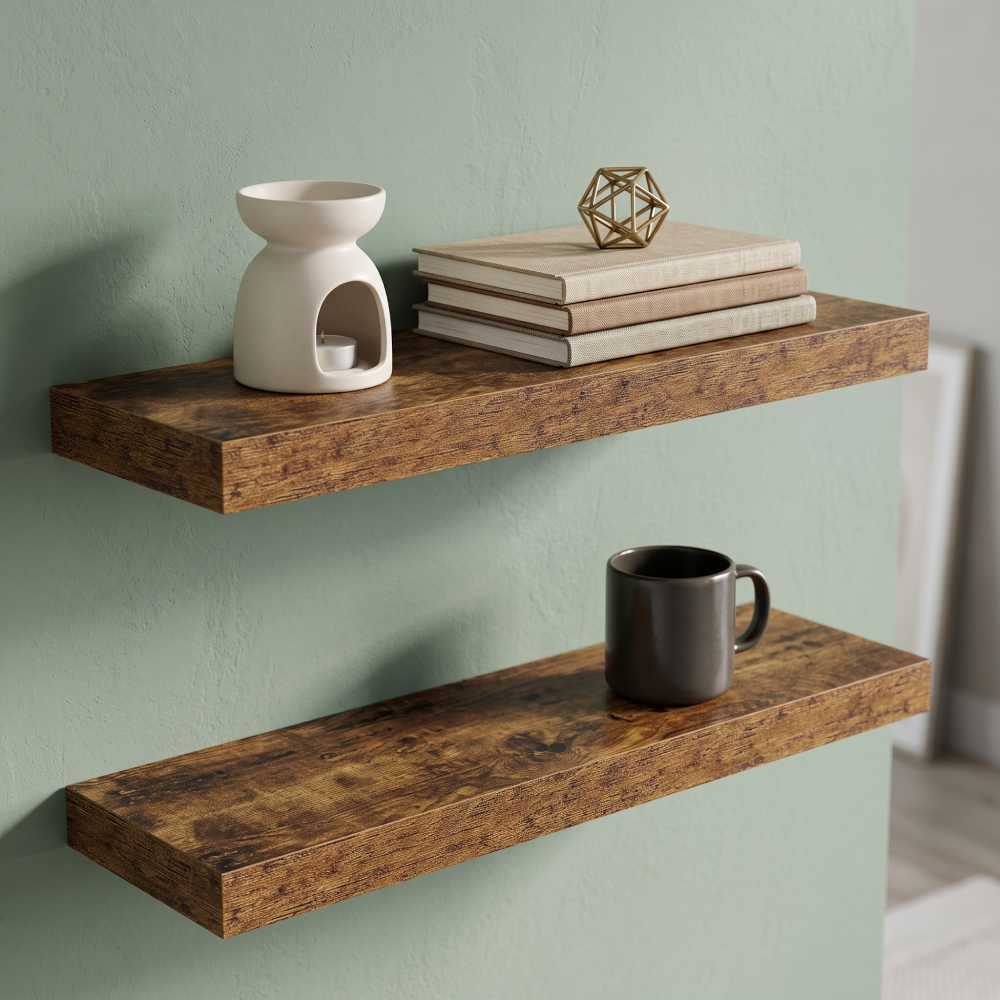
Image is for illustration purposes only. See the Amazon product page for actual photos.
Slim Floating Shelves 30 Inch, Rustic Brown Set of 2
What we like
The slimmest profile here, which is what you want when the shelf should disappear.
Worth knowing
A 1.1 inch board is markedly less stiff than 1.5, and this one spans 30 inches.
Price and availability change on Amazon, always confirm before buying.
Why we picked it
At 1.1 inches this is the slimmest floating shelf we have covered, and that is a real design choice rather than a corner cut.
A thick shelf reads as architecture. A 1.75 inch slab looks like it was built into the wall, which is exactly what some rooms want. A slim shelf does the opposite: it puts a fine line across the wall and lets whatever sits on it take the attention.
For a gallery arrangement of framed art, a row of ceramics, or a minimal display where the shelf should not compete, thin is the better answer. The five finish options, from white through oak tones to black, make the same point.
But thickness is structural as well as visual, and the relationship is steeper than most people expect.
A shelf resists bending in proportion to the cube of its thickness. That means a 1.5 inch board is not 36 percent stiffer than a 1.1 inch one, as the measurements suggest. It is about two and a half times stiffer. A 1.75 inch board is roughly four times stiffer.
So a slim shelf gives up a great deal of resistance to bowing, and this one is asked to span 30 inches, which is longer than most of the shelves in this category.
That does not make it a bad shelf. It makes it a shelf with a narrower brief. Loaded lightly and evenly, with framed pictures, small plants and objects spaced along its length, it will look exactly as intended. Loaded heavily in the middle, a thin board over a long span is where visible sag begins.
The practical rule follows directly from the physics. Where you put the weight matters more on a thin shelf than a thick one, because a stiffer board distributes a point load along its length while a thin one deflects locally around it.
So spread objects along the shelf rather than clustering them, and put anything heavy near where the brackets enter the wall rather than out in the middle of the span. On a 1.75 inch shelf you could ignore that advice. Here it is worth following.
There is a second consequence of a slim profile worth understanding. Concealed brackets work by routing channels into the shelf body so the support rods disappear inside it. On a 1.75 inch shelf there is plenty of material above and below the rod. On a 1.1 inch shelf there is very little.
That means slim floating shelves depend more heavily on being mounted correctly, since there is less material to distribute any load that is not sitting squarely on the bracket. Fixing into studs matters more here than on a thicker shelf, not less.
At 30 inches the length has a genuine advantage. US wall studs typically sit at 16 inch centers, so a 30 inch shelf spans nearly two full bays and can reach two studs with sensible placement, where a 16 inch shelf often manages only one.
Two solid fixings is exactly what a slim shelf needs, so length and thickness work together here if you mount it properly.
The 6.5 inch depth is well judged for the profile. Deep enough for framed pictures to stand without overhanging and for small plants, shallow enough to keep the leverage on the brackets modest, which matters more on a thin board.
The material is engineered wood with a laminated wood-grain finish. The listing describes it as realistic rather than real, which is an honest way to put it, and a printed grain is the expected trade at this profile since a 1.1 inch solid timber shelf would be more prone to warping than a board one.
What’s in the box
| Quantity | 2 shelves |
| Size each | 30 inches long by 6.5 deep by 1.1 thick |
| Profile | 1.1 inches, the slimmest we have covered |
| Capacity | 25 pounds per shelf, around 0.83 pounds per inch |
| Material | Engineered wood with a laminated wood grain finish |
| Brackets | Concealed, mounting hardware included |
| Stud reach | 30 inches spans nearly two 16 inch bays |
| Finishes | Five, from white through oak tones to black |
The honest take
What we like
- Slimmest profile here, so the shelf recedes and the display leads
- 30 inches spans nearly two stud bays, so two fixings are reachable
- 6.5 inch depth keeps leverage modest on a thin board
- Five finish options, more than any shelf we have covered
- Suits gallery arrangements and spaced displays
- Mounting hardware and instructions included
Worth knowing
- A 1.5 inch shelf is around two and a half times stiffer than 1.1 inches
- 30 inches is a long span for a thin board
- Spread the load rather than concentrating weight mid span
- Less material around the bracket, so mounting into studs matters more
- 0.83 pounds per inch is low against shorter, thicker shelves
- Laminated printed grain rather than real wood
A fine line across the wall
Check current pricing and availability for these fuqing Floating Shelves on Amazon.
Check Price on AmazonPurchases made through this link support Homeander at no extra cost to you.