The Art of Warm Minimalism: How to Decorate a Cozy, Clutter-Free Home
Minimalism got a reputation for feeling like a dentist’s waiting room. Here’s how to keep the calm and lose the chill.
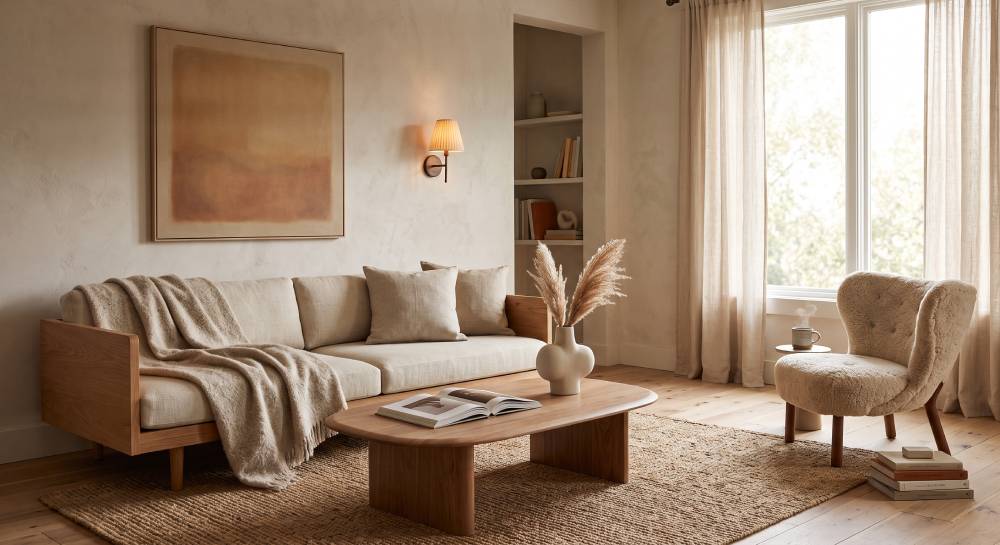
You’ve seen the room. White walls, concrete floor, one chair nobody sits in. It photographs beautifully and feels like nobody lives there.
That’s the version of minimalism that put a lot of people off. Somewhere along the way, “less stuff” got confused with “less warmth” — and the result was interiors that looked more like galleries than homes.
Warm minimalism corrects that. Same discipline about what you keep. Completely different feeling once you walk in.
The difference comes down to three decisions, and the first one surprises most people.
1. Texture does the work that clutter used to
Here’s the trap. When you strip a room back to fewer objects, you also strip out visual interest — so the space reads flat and cold. The instinct is to add things back. Usually the wrong things.
The fix isn’t more objects. It’s more surface.
A room with five materials in it feels rich even if it only contains five items. Bouclé against smooth linen. Oak grain against matte ceramic. A jute rug underfoot with a wool throw over the sofa arm. Your eye reads all of that as depth, and none of it counts as clutter.
Try this: look at a room you find cold and count the distinct textures. It’s usually two — paint and one upholstery fabric. That’s the actual problem, not the number of things on the shelf.
The rule of thumb: aim for at least four distinct textures in any room you want to feel warm. Wood, woven, soft, and something with a bit of grit — stone, ceramic, raw plaster. Below four, the space starts feeling clinical no matter how good the furniture is.
Natural fibres do this better than synthetics, and not just aesthetically. Linen creases. Wool has irregular loft. Real wood has grain that moves. Those imperfections are what your brain reads as “lived in” rather than “showroom.”
2. Your neutrals are probably the wrong temperature
Now for the part that quietly ruins more rooms than anything else.
Neutral doesn’t mean grey. Every neutral has a temperature — a subtle lean toward blue or toward yellow — and cool-leaning neutrals are exactly what makes a minimalist room feel severe.
Pure white walls with grey furniture and chrome fittings? That’s three cold decisions stacked on top of each other. No amount of throw blankets will rescue it.
Warm minimalism uses the same restraint but shifts the whole palette a few degrees toward yellow:
- Instead of pure white — a soft off-white, chalk, or warm plaster tone
- Instead of cool grey — greige, oatmeal, mushroom, taupe
- Instead of black accents — deep brown, charcoal with a warm base, or aged brass
- Instead of chrome — brushed brass, bronze, or unlacquered copper
Notice these are still neutral. Still restrained. Nothing here is a bold colour choice. But the room they produce feels completely different to stand in.
And there’s one more layer that decides whether any of this actually lands.
3. Lighting is the whole game
You can get texture and palette perfect and still end up with a room that feels like an office. Usually there’s one reason.
A single ceiling light.
Overhead lighting flattens everything. It casts even, shadowless light from directly above, which is exactly how commercial spaces are lit — and exactly why a room lit that way never feels relaxing, regardless of what’s in it.
Warm rooms use multiple light sources at different heights. A floor lamp in a corner. A table lamp at eye level beside a chair. Maybe a candle or a low light on a shelf. Each one creates shadow, and shadow is what gives a room depth.
Two specifics worth getting right:
- Bulb colour temperature. Look for 2700K on the packaging. That’s warm white. 4000K and above is daylight, which is excellent for a kitchen work surface and terrible for a living room.
- Dimmers wherever possible. A room needs different light at 3pm than at 9pm. Fixed brightness means it’s wrong at least half the time.
If you change one thing after reading this, make it the bulbs. It costs almost nothing and it’s the single fastest way to warm up a room you already own.
What “clutter-free” actually means here
Worth clearing up a misconception, because this is where warm minimalism differs most from the stark version.
The goal isn’t empty surfaces. It’s intentional surfaces.
A stack of three books, a ceramic bowl, and a small plant on a console table isn’t clutter — it’s a considered arrangement with breathing room around it. Eleven items on the same table is clutter, because nothing has space to be looked at.
The practical test: can you see the surface the objects are sitting on? If the answer is no, the arrangement is too full. That’s it. That’s the whole rule.
Where to start
If your room already feels cold and you want the fastest route to fixing it, do these in order:
- Change the bulbs to 2700K. Cheapest change, biggest immediate difference.
- Add a second light source at a lower height than the ceiling.
- Introduce two new textures — a woven throw and a natural-fibre rug will usually do it.
- Clear one surface down to three objects, and leave the space around them.
None of that requires repainting or buying furniture. It’s a weekend at most, and you’ll notice the difference the first evening you sit in the room after dark.
Which is really the point. A warm minimalist room isn’t one that looks good in photographs. It’s one you want to be in when nobody’s looking.