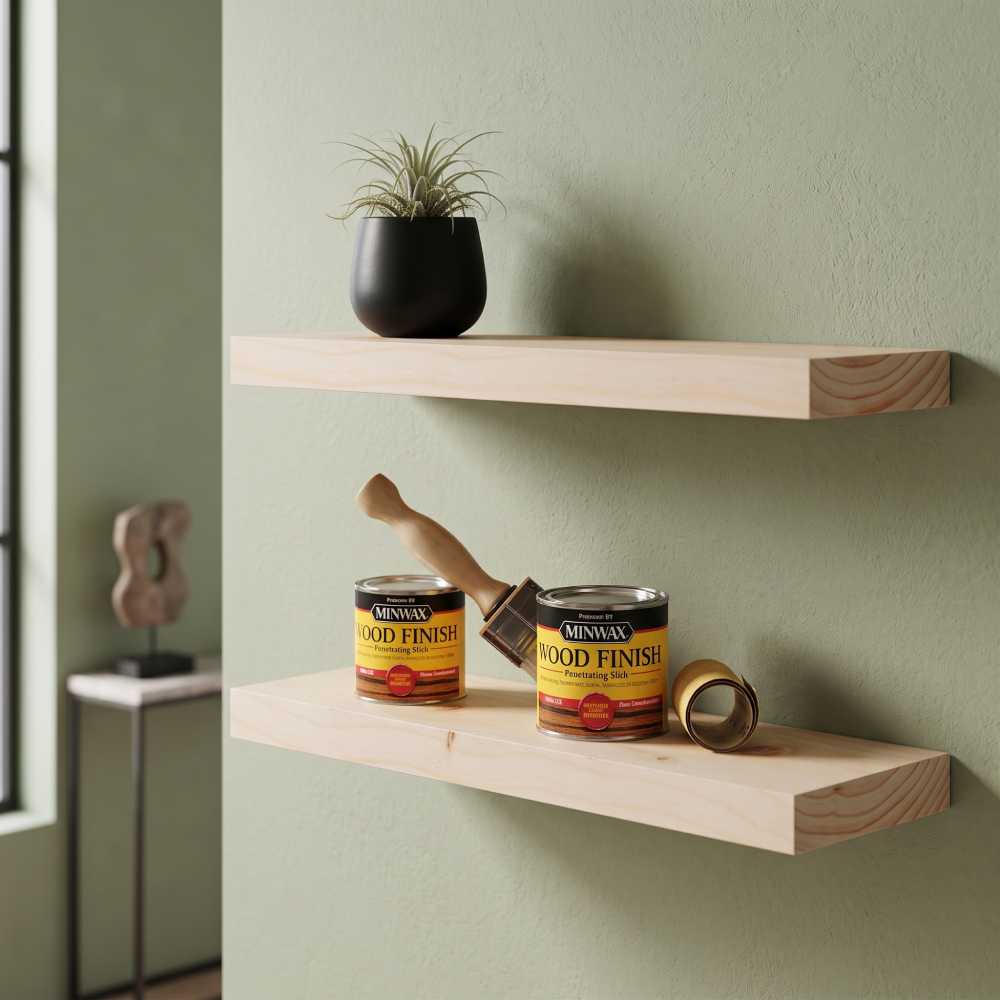
Image is for illustration purposes only. See the Amazon product page for actual photos.
Unfinished Floating Shelves 24 Inch, Raw Pine Set of 2
What we like
You match the finish to cabinetry you already own rather than hoping it works.
Worth knowing
Pine blotches under stain unless you use a conditioner first. Plan for that.
Price and availability change on Amazon, always confirm before buying.
Why we picked it
Buying a shelf unfinished solves a problem that no amount of choosing between factory finishes can.
Wood tones are difficult to match from a photograph. A shelf described as oak or walnut arrives in whatever that manufacturer means by it, and next to kitchen cabinetry or an existing piece of furniture, close-but-wrong reads worse than obviously different.
Raw wood removes the guesswork. You take the stain or paint to the thing you are matching, test it, and get the result you actually wanted. For a shelf going above a vanity, beside built-in cabinets, or into a room with a committed color scheme, that control is the whole argument.
It also opens options a factory finish forecloses. Paint it to disappear into the wall, oil it for a warm low-sheen look, or seal it clear to keep the pale raw tone, which is a look factory shelves rarely offer.
Now the part that decides whether this goes well, and the listing deserves credit for raising it. Its own copy warns that raw pine can take stain unevenly and advises testing on the back edge first.
That is not a disclaimer, it is genuinely how pine behaves. Pine grows in alternating bands of dense latewood and porous earlywood. The porous bands absorb stain readily and the dense bands resist it, so a dark stain applied straight to bare pine comes out patchy, and the effect is most obvious across a wide flat face like a shelf top.
The fix is standard and worth knowing before you start. A pre-stain wood conditioner partially seals the thirsty areas so the stain absorbs more evenly. It goes on before the stain, takes a few minutes, and is the difference between an even tone and a blotchy one.
If you would rather not deal with that at all, paint is the forgiving option, since it covers the variation entirely. Oil and clear sealers are also far less prone to blotching than pigmented stains.
Two practical points on finishing a floating shelf specifically.
Finish it before mounting. Once the bracket is in the wall and the shelf is on it, the underside and the back edge are effectively unreachable, and brushing a shelf in place drips onto whatever is below.
And finish all faces, including the underside and the ends. An unsealed face absorbs moisture from the air at a different rate than a sealed one, and uneven moisture movement is what makes a board cup over time. Sealing both sides keeps the shelf flat.
Underneath the finish question, this is a well specified shelf. Solid pine throughout rather than board with a printed wrap, 1.75 inches thick, and rated at 50 pounds per shelf.
At 24 inches it spans a full stud bay, so with sensible placement it reaches two studs rather than one. That matters, because the 50 pound rating applies to stud mounting. The listing says so plainly and provides anchors for drywall as the fallback, but a full row of hardcovers across 24 inches runs close to 40 pounds and belongs in timber.
One consequence of real wood worth expecting: knots, grain and tone vary from board to board, so your two shelves will not be identical even before you finish them. Test any stain on the back edge of each shelf rather than assuming they will take it the same way.
What’s in the box
| Quantity | 2 shelves |
| Size each | 24 inches long by 6.5 deep by 1.75 thick |
| Material | Solid pine, sanded smooth, left bare |
| Finish | None. Stain, paint, oil or seal it yourself |
| Bracket | Concealed metal, screws and anchors included |
| Capacity | 50 pounds per shelf when mounted into studs |
| Before staining | Use a pre stain conditioner; pine blotches without one |
| Note | Finish all faces before mounting, including the underside |
The honest take
What we like
- Match the finish to cabinetry you already own rather than guessing
- Opens options a factory finish forecloses, including paint and clear
- Solid pine throughout, not board under a printed wrap
- 1.75 inches thick, the thickest shelf we have covered
- 24 inches spans a stud bay, so two fixings are reachable
- The listing warns about uneven stain rather than staying quiet
Worth knowing
- Pine blotches under dark stain without a pre stain conditioner
- Finishing is a separate job with its own cost and drying time
- Must be finished before mounting, since the underside becomes unreachable
- Seal all faces or the board can cup over time
- The two shelves will differ in grain and tone
- The 50 lb rating applies to stud mounting, not drywall anchors
Your finish, not theirs
Check current pricing and availability for these Homeforia DIY Pine Shelves on Amazon.
Check Price on AmazonPurchases made through this link support Homeander at no extra cost to you.