How to Style Curtains: Simple Ideas to Make Windows Look More Finished
Most curtains that look wrong aren’t the wrong color. They’re hung too low, too narrow, or at the wrong length for what they’re actually supposed to do.
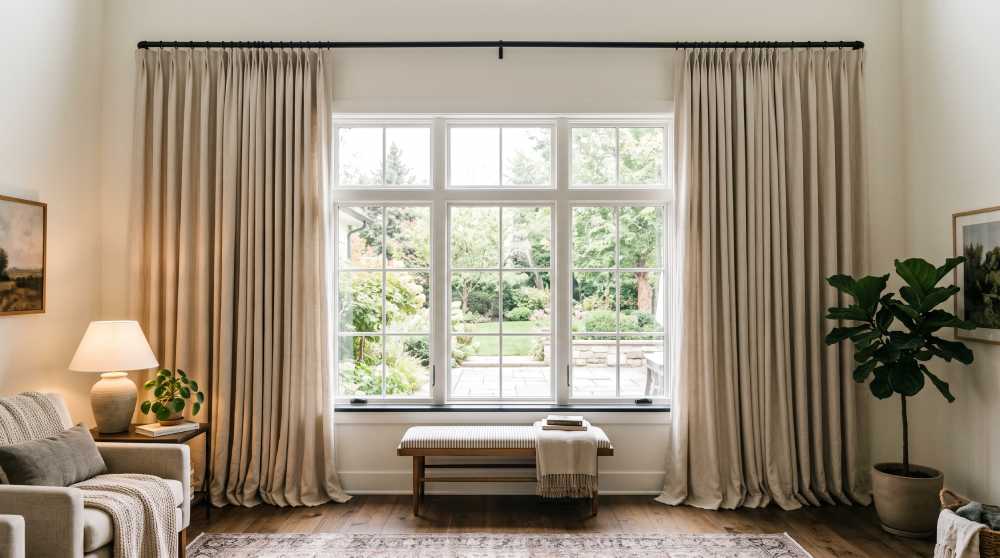
Curtains get blamed for a lot of problems that aren’t actually about the curtains. A window can have beautiful fabric in exactly the right color and still look off, because the length is wrong, the rod is too narrow, or the panels are hung too low to do the job they’re meant to do. Fixing those mechanical details usually does more for a window than swapping the fabric ever will.
Get the length right for what you want them to do
Three lengths cover almost every situation. Floor length, panels that just graze the floor or break slightly like a pair of pants, is the safest default and works in nearly any room. Puddle length, with a few extra inches pooling on the floor, reads as more formal and suits rooms that don’t see heavy foot traffic near the window. Above the sill or apron is a practical choice for a window over a kitchen sink or a radiator, where longer panels would be in the way, but it’s the one length that tends to look unfinished in a living room or bedroom. Whatever length you land on, curtains that stop a few inches short of any of these three, hovering awkwardly above the floor, are the single most common length mistake.
Hang the rod higher and wider than the window frame
This is the fastest fix available and it costs nothing but a different set of screw holes. Mounting the rod four to six inches above the window frame, and extending it four to ten inches past each side, makes the window itself look taller and wider once the curtains are open, because the fabric stacks against the wall instead of covering the glass. A rod mounted directly on the window frame, with panels that only just clear the width of the glass, is what makes curtains look like an afterthought rather than a considered part of the room.
A window styled well and a window styled poorly are often wearing the same curtains. The difference is almost always in the rod, not the fabric.
Choose fabric weight for the room’s job, not just the look
Heavier fabrics like velvet or a lined cotton block more light and sound, and suit bedrooms or rooms that face a busy street. Lighter fabrics like linen or a sheer voile let light filter through while still softening a window’s hard edges, and work well in living rooms and kitchens where you want privacy without losing daylight. Choosing a heavy blackout fabric for a room where you actually want morning light, or a sheer panel for a bedroom that needs to stay dark, is a mismatch that shows up in daily use even if the fabric looked right in the store.
Layer curtains with blinds or sheers for more control
A single fabric panel has to do everything: block light, offer privacy and look good, and it rarely does all three perfectly. Layering a sheer panel underneath a heavier drape, or pairing blinds with curtain panels on either side, splits that job. The sheer or blind handles daytime privacy and light control, while the outer curtain adds the color, texture and formality. This setup uses either a double rod, one mounted slightly in front of the other, or a single rod wide enough to hold both layers without crowding.
Decide whether the curtains should match the wall or stand out
Curtains close to the wall color make a room feel larger and calmer, since the eye reads the wall and window as one continuous surface. Curtains in a contrasting color turn the window into a feature and add visual interest, but they also draw more attention to the window’s proportions, so this works better on a well-placed window than an awkward one. Neither approach is wrong, but choosing based on what you want the window to do (blend in, or become a focal point) is more useful than picking a color you simply like.
Coordinate with what’s already in the room
Curtains don’t need to match the rest of the room exactly, but they should share at least one color or texture with something else nearby, a pillow, a rug, or the bedding if the window is in a bedroom. That single point of connection is usually enough to keep the curtains from feeling like a separate decision made in isolation. If you’re coordinating a bedroom window with the bed itself, our guide to layered bedding covers the same palette logic (one main color, one accent, a neutral to connect them) that applies just as well to curtains.
Once the mechanics are right, choose a direction
Length, rod placement, fabric weight and layering are the decisions that make curtains function well in any style. Once those are settled, the style itself is a separate choice. Our roundup of curtain ideas covers a range of looks to draw from, and if the window in question is in a bedroom, our bedroom curtain ideas narrows that down further.
If a window still looks unfinished after choosing a good fabric and color, check the rod height and width before changing anything else. That’s usually where the real problem is.