How to Make a Small Room Look Bigger With a Rug
Most people undersize a rug in a small room on purpose, thinking it’ll look less crowded. It almost always does the opposite.
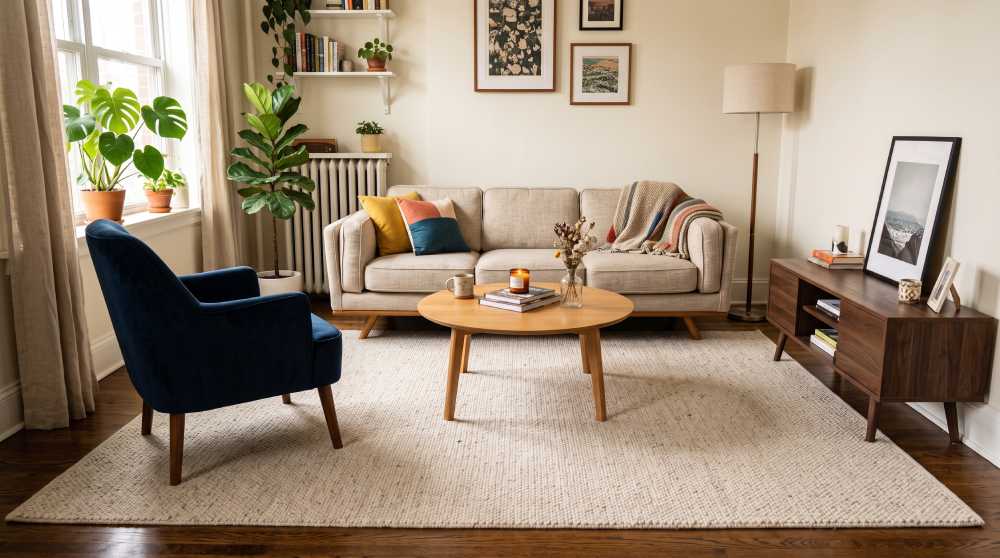
The instinct in a small room is to buy a small rug, on the theory that a large one will overwhelm the space. It’s the opposite of what actually happens. A too-small rug chops the floor into visible segments, a strip of bare floor, then rug, then more bare floor, and that segmentation is what reads as cramped. A single, larger surface does more to open a small room than a modest one ever will.
Size up, not down
In a small room, the rug should cover as much of the visible floor as reasonably fits, leaving a consistent, narrow margin of bare floor around the edges rather than large uneven gaps. The goal is for the floor to read as one continuous surface interrupted only slightly at the walls, not as a patchwork of rug and bare flooring competing for attention. If you’re unsure how to measure for the right size in the first place, our guide to common rug-buying mistakes covers the sizing math in more detail.
Get the furniture legs onto the rug
A rug that only sits under a coffee table, with the sofa and chairs entirely off it, visually shrinks the seating area to just that small patch of rug. Getting at least the front legs of every seat resting on the rug, ideally all four legs where the room allows it, ties the whole furniture grouping into one visual zone rather than leaving pieces of furniture floating separately around a small central rug.
A small rug doesn’t make a small room feel bigger. It makes the room’s smallness more obvious by drawing a border around exactly how little floor there is.
Choose light, and keep the pattern quiet
Light colors, cream, pale gray, soft sand, reflect more light than dark ones, and a floor that reflects light reads as more open than one that absorbs it. This doesn’t mean a small room needs a plain rug; a subtle, small-scale pattern or a tone-on-tone texture still works well and helps hide everyday wear, but a large, high-contrast pattern draws the eye down to the rug’s edges and makes the boundaries of the space more noticeable, which works against the goal.
Match the shape to the room’s own lines
A rectangular room with rectangular furniture generally looks most open with a rectangular rug that echoes those same lines, since it reinforces the room’s existing geometry rather than introducing a competing shape. A round rug can work well under a round table or in an awkwardly shaped room where you want to soften hard corners, but in a small rectangular room a round rug often leaves triangular patches of exposed floor at the corners that break up the continuous surface you’re trying to create.
Use one rug, not several
Splitting a small room’s floor between two or three smaller rugs, one by the door, one under the coffee table, one by a chair, multiplies the visual breaks in the floor and makes the space feel busier and more divided than it is. One larger rug covering the main furniture grouping does more for a small room’s sense of scale than several smaller ones spread around it, even at a similar total cost.
Leave a visible, even border of floor
A rug pushed flush against the walls on one side, with a wide gap on the other, looks accidental rather than placed, and an uneven margin draws attention to the room’s actual boundaries. Centering the rug on the furniture grouping, with a roughly even gap of exposed floor on all sides, whatever that gap ends up being given the room’s size, reads as intentional and keeps the eye moving smoothly from rug to floor rather than stopping at an odd edge.
If in doubt, size up rather than down. The rug that feels almost too large for a small room is very often the one that actually makes it feel bigger once it’s down.