Chunky Knits and Charred Tones: Styling Layered Throws for Chilly October Nights
Autumn coziness isn’t more blankets. It’s two or three heavy textures in a tight, smoky palette, layered so each one actually shows.
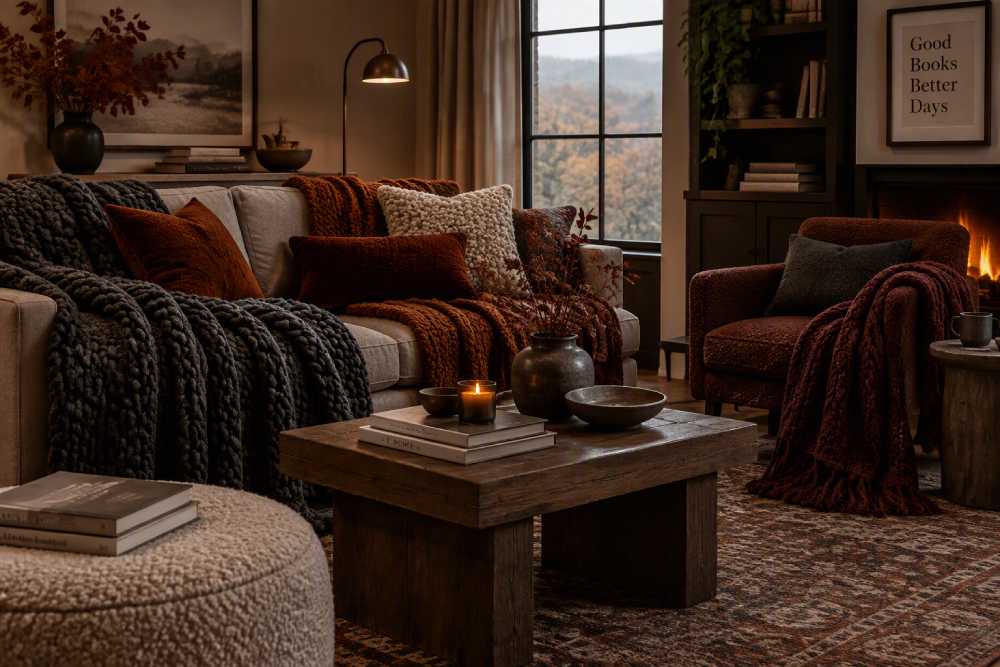
The first properly cold evening of October changes what a living room is for. The sofa stops being somewhere to sit upright and becomes somewhere to disappear into, and the throws that did nothing but sit folded all summer suddenly have a job. The difference between a room that feels cozy and one that just has blankets in it comes down to a few decisions about texture, weight and color, and none of them require buying much.
Swap the weight before you add anything
The most overlooked autumn move is subtraction. Put the lightweight cotton and linen throws away, and bring the heavy ones forward. A room that goes from three light summer throws to two heavy autumn ones reads as warmer immediately, because the eye picks up weight and pile before it picks up color. Start there, and add a third piece only if the seating still looks bare.
Four textures worth knowing
Heavyweight autumn throws mostly fall into four families, and knowing which is which makes it easier to mix them on purpose rather than by accident.
Chunky knit is built from thick yarn in large, visible stitches. It has the most obvious pattern and the most weight, and it catches on anything rough, so keep it away from velcro and unfinished wood. A chunky knit throw is the easiest way to get an unmistakably autumn texture in one piece.
Boucle uses looped yarn, which gives a nubby, uneven surface that scatters light instead of reflecting it. It reads as soft and slightly rustic at the same time.
Chenille has a dense, fuzzy pile that drapes heavily and changes shade slightly depending on which way you brush it. It is the plushest of the four and the one that looks richest in deep colors.
Waffle knit has a grid of small recessed squares. It is usually lighter and more breathable than the others, which makes it a good middle layer rather than a top one.
Two throws in the same texture look like a set. Two throws in different textures look like a decision.
Build the palette from soot, rust and oxblood
These three colors sit in the same warm, smoky family, which is why they work together so reliably. Soot, a charcoal that leans black, is the grounding color. Rust is the warm accent. Oxblood, a deep red-brown, sits between the two and can act as either. The simplest approach is the one-main, one-accent logic used for any palette: let soot anchor the seating, add rust or oxblood as the accent, and use the third only as a small hit like a single pillow cover. Our guide to mixing pillow colors covers that anchor-plus-accent logic in more detail.
A near-black piece like a black fleece throw gives you the soot layer without any pattern to compete with, while a rust throw supplies the warm accent against it. Rust and oxblood are close enough that using both at full strength on one sofa tends to blur together, so give one of them the lead.
Layer by weight, not just by color
When you use more than one throw on a seat, vary the weight and the scale of the texture. Put the heavier, chunkier piece underneath or at the back, and a lighter or smoother one on top where it can show. Two equally heavy throws stacked together turn into one bulky lump, while a heavy piece with a lighter one over it keeps both visible. For how to actually fold and position them, our sofa throw styling guide covers the mechanics.
Sofa and reading chair want different things
On a sofa, two throws is usually the ceiling: one at each end, or both layered at one corner, with the rest of the seat left clear. On a reading chair, one throw is enough, hung over the back and arm so it can be pulled across your lap. Chairs are smaller, so a second throw there starts to look crowded, and it blocks the one thing a reading chair is for, which is sitting in it.
Finish with evening light
Heavy textures only look as good as the light falling on them. A lamp beside the chair at seated height, in a warm bulb, brings out the depth in boucle and chenille in a way overhead light flattens. Our guide to warmer room lighting covers the bulb color and placement that make this work.
A quick care note for heavy knits
Chunky knits and chenille are the pieces most likely to snag, shed or stretch out if washed carelessly, so check each label before the first wash. Many heavy knit throws do better laid flat to dry than tumbled, and a throw you can’t easily wash tends to stay on the sofa less often than one you can. It is worth factoring in before you commit to a color you’ll be using every night for the next three months.
Pick the soot layer first, add one warm accent, and let two different heavy textures do the rest. The room will feel colder-weather ready long before it looks decorated.