Setting the Stage: Transforming Rooms with Dramatic Floor-to-Ceiling Velvet and Sheer Ghostly Drapes
A haunted-manor room isn’t built from props. It’s built from two layers of fabric and what they do to the light at 4 p.m. and at 9 p.m.
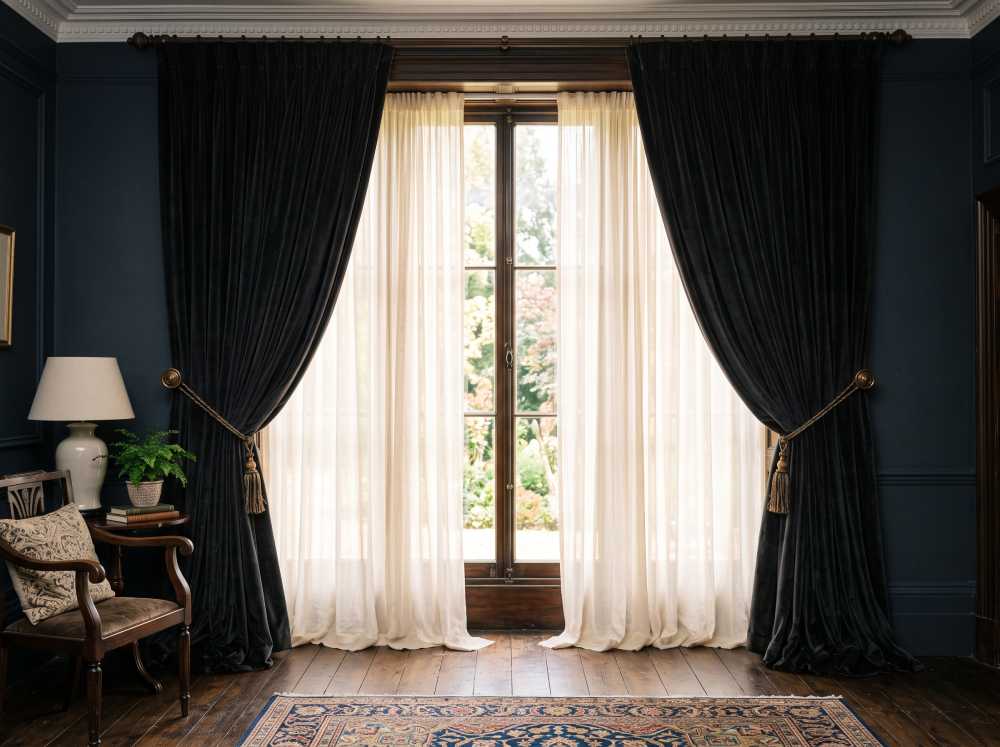
Every old house in every film has the same trick: tall windows, heavy drapes, and something pale behind them catching the light. It isn’t the furniture that makes those rooms feel dramatic. It’s the way the light is filtered, blocked and let back in. You can get the same effect at home with two curtain layers, and unlike a box of Halloween decorations, it keeps working all winter.
Two layers, two jobs
The velvet and the sheer do opposite things, and that contrast is the whole point. Velvet has a dense pile that soaks up light, so it reads as deep and shadowy even in daytime, and when it’s closed it stops most of the light coming in. The sheer does the reverse. It lets light through but scatters it, so the window turns into a soft, even glow instead of a bright rectangle with a view. Put them together and you can move a room from foggy afternoon to candlelit evening just by drawing one layer or the other.
Go floor to ceiling, and let the velvet fall
Height is what turns curtains into a backdrop. Mount the rod close to the ceiling rather than just above the window frame, and let both layers run all the way to the floor. Velvet is heavy enough to break or pool slightly at the floor and still hang straight, which is part of what gives it that grand, slightly theatrical look. Keep the pooling to an inch or two if the curtains get opened and closed every day, since more than that drags and collects dust. Our curtain styling guide covers rod height and length in more detail.
Give the sheer more fabric than the velvet
The two layers need different amounts of fullness to look right. Sheers are light and nearly transparent, so they need a lot of fabric gathered together, often around two and a half times the rod width, before they look soft rather than thin. Velvet is heavy and opaque, so around twice the rod width is usually enough to look rich.
Here’s what that means on a real window. Take a 60 inch window with the rod extending 10 inches past each side, for an 80 inch rod. At 2.5 times, the sheer needs about 200 inches of total panel width. At 2 times, the velvet needs about 160 inches. Buying the same number of panels for both layers is one of the most common reasons a layered window looks either skimpy or bulky. Our curtain width guide walks through the full calculation.
By day, the sheer gives you privacy and the velvet gives you drama. After dark, it’s the other way around.
Know what each layer does after dark
This is the part that catches people out. A sheer gives privacy during the day because it’s brighter outside than in, so people looking in mostly see glare. Once the lamps come on at night, that flips, and anyone outside can see into a lit room through the sheer quite clearly. So the routine is simple: sheers drawn during the day for that hazy, ghostly light, velvet closed in the evening for privacy and that enclosed, shadowy feeling.
Decide which layer goes in front
The standard setup is a double rod with the sheer on the back rod, closest to the glass, and the velvet in front, where it can be pulled open to frame the window. That’s the most practical arrangement and the one most people should start with.
For a more unusual, dreamlike look, some designers reverse it and hang the sheer in front of the velvet. The heavy fabric shows through as a darker shadow behind a pale veil, which is about as close to a haunted-manor window as fabric gets. It’s less practical for daily use, but it’s striking in a room you mostly sit in at night.
Velvet isn’t automatically blackout
A lot of velvet curtains look like they’d block all light but don’t. If you want the room genuinely dark, check the listing for a blackout lining or a stated blackout rating rather than assuming the weight alone will do it. Light also sneaks in around the edges, mostly at the top and sides. A rod that extends well past the frame, and panels wide enough to overlap in the middle, close most of those gaps. A wraparound rod that curves back to the wall closes the rest.
Choose colors that read as moody, not costume
The velvet is where the color lives. Oxblood, deep forest green, charcoal and plum all give that rich, old-house look, and they work well past October. For the sheer, a warm ivory or a smoky gray tends to read as atmospheric, while bright white can look clinical next to dark velvet. Gray sheers in particular give daylight a slightly overcast, misty quality, which is exactly the effect you want. Leave the orange and the printed bats out of it entirely; the drama should come from the fabric and the light, not the pattern.
Light the sheer from the room side at night
After dark, the sheer can still earn its place. With the velvet pulled back, a lamp in the room gives the sheer a faint warm glow, and a small, cool-running LED lamp like a cordless rechargeable table lamp set on the sill behind the sheer makes the whole panel glow softly from within. Keep the fabric from resting against any light, and stick to LEDs near curtains. Never put candles anywhere near a sheer; it’s the most flammable thing in the room. For the room itself, a mid-century floor lamp with a fabric shade at the end of a sofa adds the low, warm light that makes the dark velvet look rich instead of gloomy. Our guide to warmer room lighting covers bulb color and placement.
Let the sheers move
The one thing that sells the ghostly effect better than any color choice is movement. A light sheer drifting slightly when a window is cracked or a heating vent kicks on is exactly the image people have in their heads. Skip weighted hems or tiebacks on the sheer layer, and let it hang free.
Hang it high, give the sheer more fabric than the velvet, and let the light do the rest. The room will look like a set long before you add a single decoration.