Bedroom Floor Lamp Ideas: Where to Place Them and How to Style Them
A floor lamp in the wrong bedroom corner just takes up space. In the right one, it does more for the room than almost any other single piece.
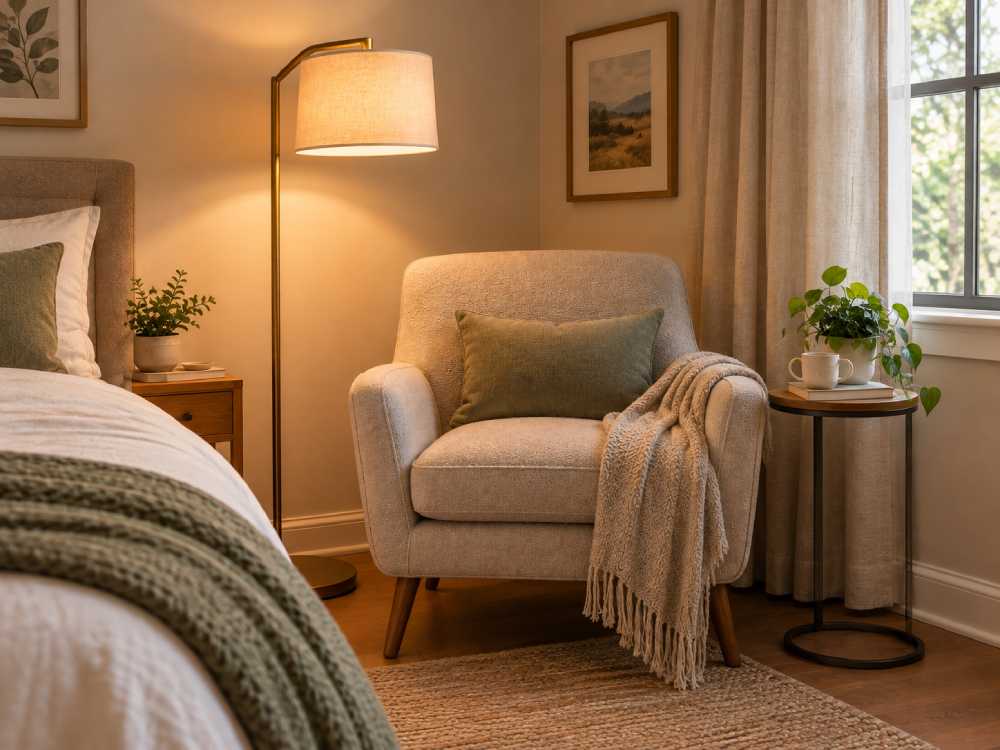
A floor lamp is one of the few pieces in a bedroom that only works if it’s placed with a specific purpose in mind. Set down in a random empty spot, it’s just a tall object taking up floor space. Placed beside a reading chair or in the one corner that never sees any light, it changes how the whole room feels in the evening. The difference is almost entirely about where it goes and how it’s sized, not which lamp you buy.
Beside a reading chair or window seat
This is the single best use for a bedroom floor lamp, and the one most people skip because they default to only lighting the bed. Position the lamp just behind and slightly to the side of the chair, close enough that the light falls directly onto a book or a lap without the shade itself being in your eyeline. This single placement does more for a bedroom’s evening usability than almost any other lighting choice, since it creates an actual reason to sit somewhere other than the bed.
As an alternative bedside light
When a nightstand is too small or too narrow for a table lamp, a slim floor lamp positioned just behind the head of the bed can do the same job without taking up any surface space at all. This works especially well with a narrow arc lamp or a slim-base floor lamp that can angle its light down toward the mattress. If you’re weighing this against a standard bedside table lamp, our guide to choosing a bedside lamp covers what to look for in the more traditional option.
In the corner that never gets used
Almost every bedroom has one corner that sits empty because nothing quite fits there. A floor lamp is one of the easiest ways to fill that gap without adding furniture, and it solves two problems at once: it gives the corner a reason to exist and it lights a part of the room that would otherwise stay dark all evening.
A floor lamp placed with no particular purpose competes with the room for floor space. Placed beside where you actually sit, it justifies the space it takes.
Getting the height right
For a lamp beside a reading chair, the bottom of the shade should sit roughly at or just below your shoulder height when seated, generally putting the overall lamp height somewhere between 58 and 64 inches for a standard chair. Too tall, and the light shines down onto your head rather than the page; too short, and the shade sits at eye level and glares directly at you. Arc floor lamps work slightly differently: the arm typically needs to extend 25 to 40 inches out from the base to reach over a chair or the corner of a bed, so measure that reach before buying one for a tight space.
Matching scale to the room
A floor lamp that’s visually heavy, a wide drum shade or a substantial base, can overwhelm a small bedroom, while a very slim, minimal lamp can look underscaled next to a larger bed or a substantial dresser. As a rough guide, the lamp’s shade diameter should feel proportionate to the piece of furniture it sits beside rather than towering over or disappearing next to it. In a small bedroom specifically, a slim-profile or arc lamp with a narrow base footprint avoids eating into already limited floor space.
Matching the lamp to bedroom decor
The lamp’s finish, matte black, brushed brass, natural wood, warm rattan, is worth choosing to repeat a material already in the room rather than introducing something entirely new. If the bed frame or nightstands are wood, a wood or rattan lamp base ties the two together; if the room has one piece of black metal hardware already, a black lamp base repeats that rather than competing with it.
Layering with bedside and ceiling light
A floor lamp works best as one layer among several rather than the room’s only light source. Paired with a bedside lamp and a dimmable ceiling fixture, it gives the room three distinct light levels: full brightness from the ceiling for daytime tasks, the bedside lamp for reading in bed, and the floor lamp for a separate seating area, so different parts of the evening can be lit differently rather than the whole room switching on and off as one unit. Our guide to warmer room lighting covers the bulb color and dimming choices that make this layering actually feel cohesive rather than mismatched.
Before buying a bedroom floor lamp, decide what it’s actually for, a reading spot, a dim corner, a bedside alternative, then size and place it around that purpose. A lamp bought first and placed second is how most of them end up in the wrong spot.