Contained and Curated: How to Choose Storage Baskets That Work
A basket that is the wrong shape for its shelf wastes space no matter how good it looks, and the wrong material for its room can ruin what you put in it. Both are fixable before you buy.
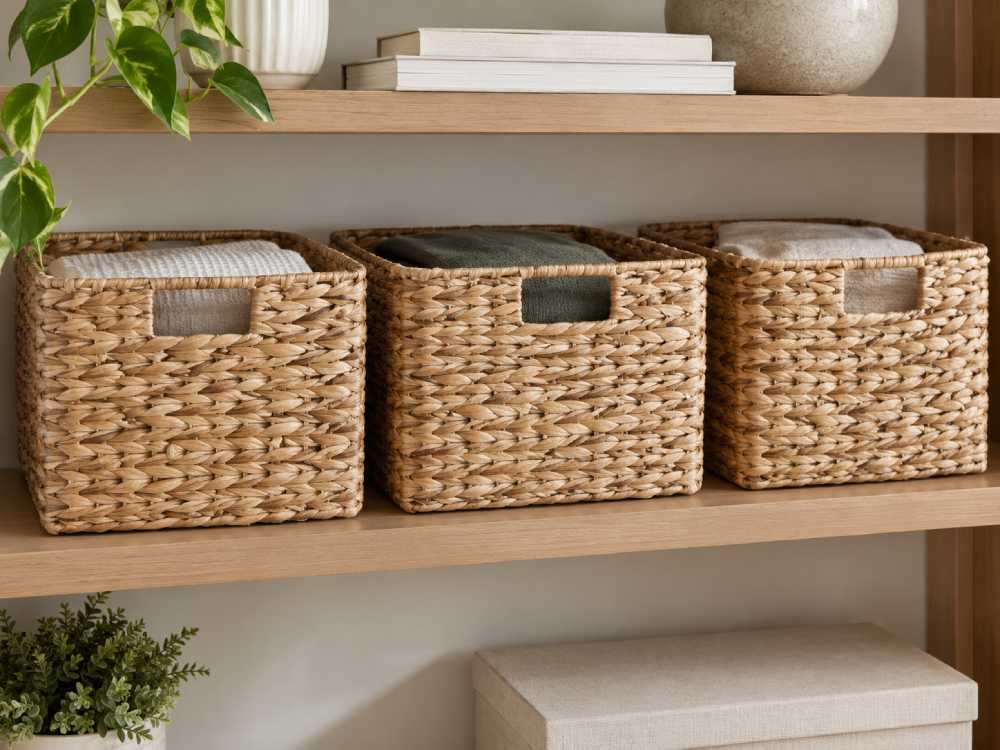
A basket looks like the easiest purchase in a room. It has no moving parts, no wiring, no assembly to get wrong. And yet more baskets end up half-used, wrongly shaped, or quietly falling apart in the wrong room than almost any other piece of home storage.
The reason is that a basket only works within a specific shelf, a specific room, and a specific job. Get any of those three wrong and a well-made basket still fails.
Measure the shelf first, not the basket
Take the depth of the shelf before you look at a single basket. This is the measurement people skip, and it is the one that determines whether the basket earns its place or leaves a strip of dead space behind it.
A basket bought shallower than its shelf looks tidy from the front and wastes real storage behind it.
- 12 inch shelf, 10 inch basket: 2 inches of dead space behind every basket
- 14 inch shelf, 11 inch basket: 3 inches lost
- 16 inch shelf, 10 inch basket: 6 inches lost, nearly two extra baskets’ worth across a run of shelving
Multiply that gap across every basket on a shelving unit and it adds up to a genuinely usable amount of missing storage, invisible from the front and permanent until you replace the baskets.
The shelf-depth rule: buy the basket within an inch of the shelf’s depth, not the width. Depth is where storage disappears; width is what you see when you walk past.
Straight sides hold more than they look like they should
Baskets are usually measured across the rim, and that is the number printed on the listing. A tapered basket, wider at the top than the base, holds meaningfully less than that number suggests.
Run the shape and the loss is larger than it looks:
- A moderately tapered basket, 13 inches at the rim narrowing to 10 at the base, holds about 22 percent less than a straight-sided basket at the same rim measurement.
- A strongly tapered basket, 14 inches narrowing to 9, holds around 33 percent less: a third of the volume the rim size implies simply is not there.
Tapered baskets are not a bad design. They stack for storage when empty and they suit a softer look. But if the goal is maximum capacity in a fixed footprint, a straight-sided basket is the more honest choice, because the number on the label is closer to the number you actually get.
Open access or a lid
This is a daily-use decision more than a styling one.
Open baskets win for anything reached for often: throws, remotes, the day’s mail, toys in active rotation. A lid adds a step between wanting something and having it, and a step people skip enough times a day becomes a reason the system stops getting used.
Lidded baskets win for anything that benefits from being fully hidden, or that needs protecting from dust: off-season bedding, documents, anything you would rather a guest not see at a glance. The lid is also the better choice for a high shelf, since it keeps dust off contents you are not looking at daily.
A useful rule: if you will open it most days, leave it open. If you will open it a few times a year, put a lid on it.
Match the material to the room, not just the look
This is where most styling advice stops at aesthetics and skips the part that actually matters: whether the material survives the room it is going into.
Water hyacinth and rattan are woven from natural fiber, and the open weave genuinely does what it claims: it lets air move through, which matters for anything organic that would otherwise trap moisture inside a closed container. A throw blanket or an out-of-season sweater stored in a sealed bin can pick up a musty smell; the same item in an open weave basket airs out.
The trade is that the fiber itself is not water-resistant. Humidity makes it swell, weaken over time, and eventually mildew, which is exactly the wrong behavior in a bathroom or laundry room. These belong in living rooms, bedrooms and entryways, not anywhere damp.
Acrylic and clear plastic are non-porous, so they do not absorb moisture or odor, which is why they suit a pantry or a bathroom. The more useful feature is transparency: you can see what is in the container without opening it, which matters most for anything you buy in multiples, like pantry staples or bathroom supplies. The trade is that a sealed acrylic container does not breathe at all, so it is the wrong choice for anything that benefits from airflow.
Wire is worth a specific mention, because it is arguably the better choice for a genuinely damp room, ahead of natural fiber. Both have an open structure that passes air, but wire itself holds no moisture, where natural fiber can still take up ambient humidity even without touching water directly. For a laundry room or a steamy bathroom, wire dries faster and will not mildew the way a woven fiber basket eventually can. The trade is the same open structure that makes it dry fast: small items fall straight through, so it suits towels and bottles rather than loose toiletries.
Canvas and felt are the soft-sided option, and two things make them the right fit for closets and children’s rooms specifically. They collapse flat when empty, which matters in a closet where baskets get rotated seasonally and need to store away themselves when not in use. And they have no rigid edges or corners, which is a real safety point in a room where a fall against furniture is more likely. The trade is that fabric absorbs moisture and stains, so keep it away from anything damp or anything likely to leak.
Styling a shelf of baskets so it reads as intentional
A row of identical baskets reads as storage. A run with the right variation reads as considered.
Keep the material consistent, vary the size. A shelf of matching weave in two or three sizes looks planned. A shelf mixing weave, wire and acrylic in one run looks like leftover containers, unless you are deliberately zoning function by section.
Label what you cannot see into. A lidded or opaque basket needs a label or it becomes a guessing game, which defeats the purpose of organizing in the first place. A simple tag on a leather loop or a small chalkboard tile keeps a closed system usable.
Leave one basket’s worth of shelf empty. A shelf packed edge to edge looks like storage; a shelf with a small deliberate gap, or one basket pulled slightly forward, looks like a room that is used rather than staged.
The short version
Measure the shelf’s depth before you shop, and buy the basket within an inch of it. Choose straight sides over a strong taper if capacity matters more than shape. Leave anything used daily open, and put a lid on anything used rarely. Match the material to the room’s moisture level, not just its color scheme, and remember that wire often beats natural fiber in a genuinely damp space.