How to Make a Sofa Look More Inviting: Simple Styling Ideas
A sofa that looks inviting almost never has more on it than one that looks cluttered. It has the same amount, arranged with more intention.
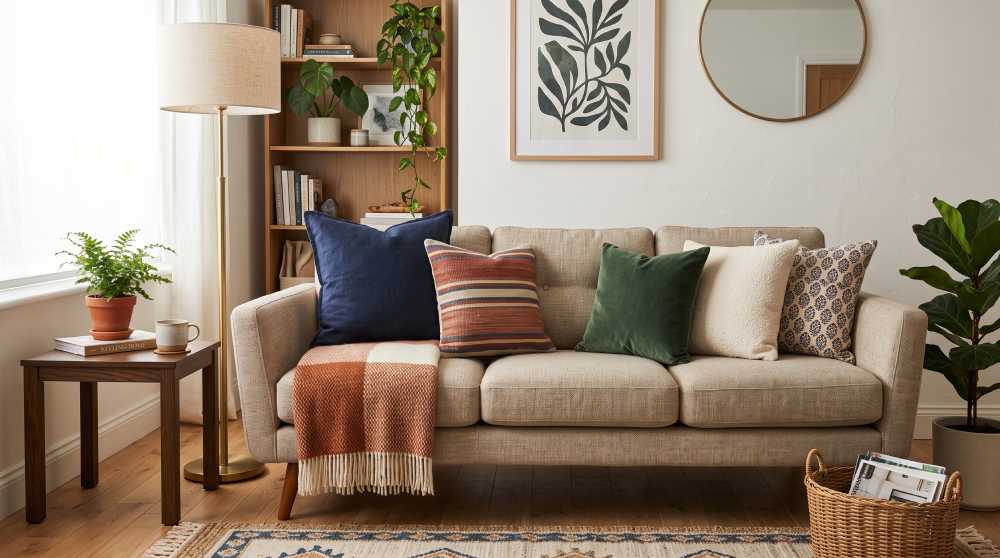
A sofa is the largest object in most living rooms, and also the one people style the least. It’s easy to buy a good one and then leave it exactly as it arrived: a plain rectangle with two matching cushions, technically finished but nothing you’d want to sink into. The gap between a sofa that looks fine and one that looks genuinely inviting is usually five small decisions, not a slipcover or a new frame.
Layer cushions in odd numbers and mixed sizes
Two identical cushions, one in each corner, is the default arrangement and also the flattest looking one. A better starting point is three or five cushions in at least two sizes: larger squares toward the back corners, one or two smaller lumbar or accent cushions layered in front, angled slightly rather than lined up perfectly straight. The unevenness is what makes it look styled rather than assembled from a box. If you’re not sure how many is too many for your sofa’s size, our guide on how many pillows to use has rough counts by seating size.
Add one throw, folded with intention
A throw blanket draped across one arm or folded over the back does more for a sofa’s warmth than almost anything else you can add, because it’s the one texture that visibly says “this gets used.” Keep it to one throw rather than two competing for the same corner, and fold it rather than letting it drape loosely; a tight fold reads as placed, a loose drape reads as left there. For the different folds and where to position them depending on your sofa’s arm style, we cover that in more depth in our sofa throw styling guide.
The most common styling mistake on a sofa isn’t too little. It’s everything at the same size, the same texture and the same color, so nothing stands out as deliberate.
Mix at least two textures
A velvet cushion against a linen throw, or a woven boucle cushion against a smooth leather sofa, creates contrast that a single fabric never will. This matters more than color choice, because texture is what a room reads at a glance, before anyone consciously notices the palette. If every soft furnishing on the sofa is the same smooth cotton, the whole arrangement flattens visually even if the colors are perfect.
Pick one anchor color, one accent
Keep the sofa’s own upholstery as the neutral base and choose one accent color that repeats across two or three of the cushions or the throw. Repetition is what reads as intentional. A single mismatched cushion in an odd color looks like it wandered in from another room; the same color repeated twice reads as a choice.
Light the sofa from more than one direction
An overhead light alone leaves a sofa looking flat and slightly clinical. A floor lamp behind one arm or a table lamp on a side table beside it adds a warm pool of light at seating height, which is closer to how the sofa is actually experienced, from someone sitting in it rather than standing above it. A candle on the nearby side table adds a third, lower point of light and some scent along with it; jar shape and wax type change how well a candle actually fills the space, which our candle buying guide covers if you’re picking one.
Style what’s next to it, not just on it
A sofa doesn’t look inviting in isolation. The coffee table in front of it and the side table beside it are part of the same picture, and a bare table next to a beautifully styled sofa still reads as unfinished. A stack of books, a small tray, one plant, arranged with the same odd-number logic as the cushions, pulls the whole seating area together. Our guide to styling a coffee table covers that surface in more detail.
Adjust the approach to your room’s style
A minimalist living room and a fuller, more layered one call for different amounts of the above, not different principles. In a pared-back room, two or three cushions and one throw, kept to a narrow color range, is enough; adding more starts to work against the room’s intent, which we talk through in our piece on warm minimalism. In a room built around a more collected, gathered-over-time look, the sofa can carry more: mismatched cushions from different sources, a patterned throw, a wider color range, in the spirit covered in our guide to building a collected home. Match the sofa’s styling density to the room around it rather than styling it the same way regardless of context.
Know where clutter actually starts
Clutter on a sofa isn’t really about quantity. A sofa with six cushions and a throw can look intentional, and a sofa with three cushions can look messy, depending on whether there’s any order to it. The signals that tip a sofa into cluttered rather than layered are usually: no repeated color or texture anywhere, cushions of all the same size with no variation, and nothing folded or arranged, just placed. Fix those three things before you consider taking anything off.
Start with what you already own. Rearrange the cushions you have into an odd number with mixed sizes, fold the throw instead of draping it, and turn on a lamp instead of the overhead light. Most of the way to an inviting sofa is rearranging, not shopping.