Common Rug-Buying Mistakes and How to Choose the Right Rug
Almost every rug that looks wrong in a room is the wrong size, not the wrong rug. Here’s how to measure before you buy one.
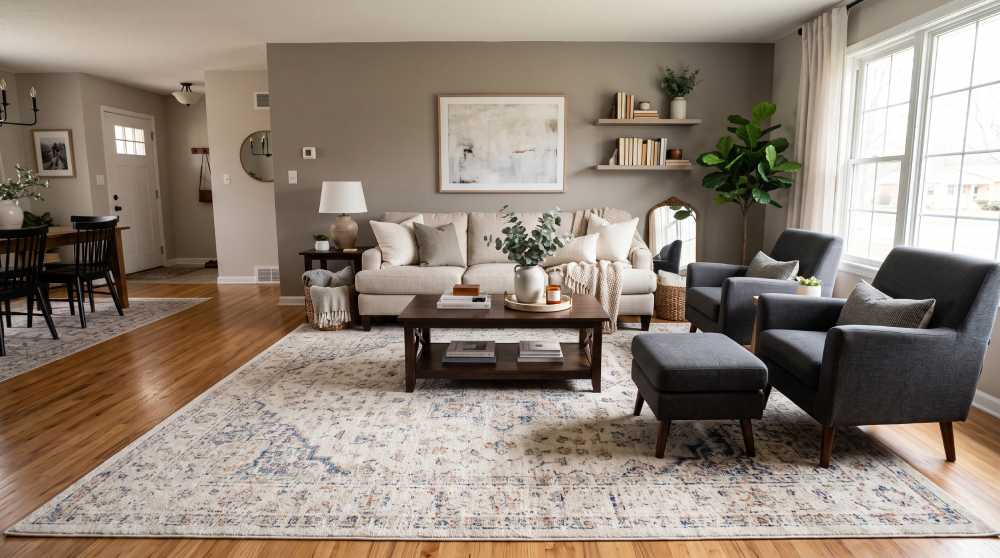
Most disappointing rug purchases aren’t a design failure. They’re a measuring failure. A rug that’s the wrong size for the room will look off no matter how good the color or pattern is, and it’s the single most common reason people end up disliking a rug they were excited about in the store or online. Getting the size, shape and placement right before you consider color solves most of the problem before it starts.
Buying too small
This is by far the most common mistake, and it happens because rugs look larger in a product photo or a showroom than they do on your own floor. A rug that only fits under a coffee table, with all the seating furniture sitting entirely off it, makes a living room look smaller and more disjointed rather than pulled together. As a working minimum, a living room rug should be large enough that at least the front legs of every sofa and chair rest on it; ideally, all four legs of each piece sit on the rug. In a bedroom, the same principle applies at the sides and foot of the bed rather than tucking the rug entirely underneath it.
Measuring the furniture instead of the floor
Before shopping, measure the actual floor space the seating area occupies, not just the furniture pieces themselves. Push the seating arrangement together the way you’d actually use it, measure the outer edges of that grouping, and add roughly 6 to 12 inches on each side for the rug to extend past the furniture. Shopping from the furniture’s dimensions alone, without accounting for the gaps between pieces, is how people consistently end up with a rug an entire size too small.
A rug one size larger than feels necessary is almost always the right call. A rug that’s too small is the mistake nobody notices until it’s already on the floor.
Choosing the wrong shape for the room
A rectangular room with a rectangular furniture arrangement usually calls for a rectangular rug, which is the default for most living rooms. A round rug works well under a round or oval table, or in a room where you want to soften a lot of straight lines and sharp furniture edges. The mistake is picking a shape because it photographed well rather than because it matches the actual footprint of the furniture sitting on it; a round rug under a rectangular sectional leaves awkward triangles of bare floor at the corners.
Picking a pattern or color that fights the room
A rug covers more visual area than almost anything else in a room, so its color and pattern carry more weight than a single pillow or throw would. Pull the rug’s dominant color from something already in the room, the sofa, the curtains, a piece of art, rather than introducing a completely new color the rug alone has to justify. If the room already has one bold pattern (patterned curtains or a printed pillow), a solid or subtly textured rug usually reads better than a second competing pattern.
Ignoring how the room actually gets used
A pale, delicate wool rug in a high-traffic hallway or a room with pets and kids will show wear and stains far faster than the same rug would in a formal, rarely used space. Material matters as much as looks here: a flatweave or a washable synthetic rug holds up to daily foot traffic and spills in a way a plush, deep-pile rug isn’t built for. Choosing based on room traffic rather than only on how a rug feels underfoot in a showroom avoids a rug that looks worn out within a year.
Skipping the rug pad
A rug pad isn’t just about comfort. It keeps a rug from sliding on hardwood or tile, which is both an appearance problem, since a shifted rug throws off the whole furniture arrangement, and a safety one. It also extends the rug’s life by reducing the friction and crushing that happen when a rug sits directly against a hard floor. Skipping it to save a small amount up front is one of the more common regrets people mention after a rug starts curling at the corners or sliding underfoot.
Positioning it wrong, even at the right size
Even a correctly sized rug can look off if it’s centered on the room rather than on the furniture grouping sitting on it, or if it’s pushed flush against a wall in a room where it should float with a visible margin of floor around it. The same front-legs-on-the-rug rule that governs sizing also governs placement, and it’s covered in more detail alongside the rest of a sofa’s styling in our guide to styling a sofa.
Once the sizing is right, choose a direction
Size, shape, material and placement are what make a rug function well in any room, regardless of style. Once those decisions are settled, style is a separate layer on top. Our living room rug ideas and our bedroom rug ideas cover style direction by room once you know what size and shape you’re actually shopping for.
Measure the floor before you fall in love with a pattern. Almost every other rug decision is easier to get right once the size is settled first.