How to Make a Room Feel Finished: 10 Details That Pull a Space Together
You don’t need a renovation to fix a room that feels almost right. Most unfinished-looking spaces are missing the same handful of small, deliberate touches, not a bigger budget.
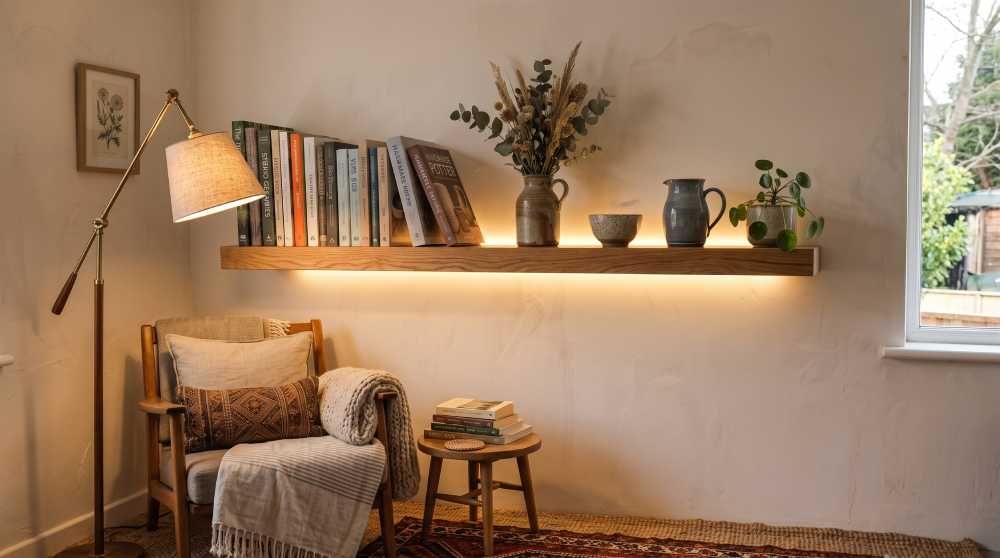
Every home has that one room. The furniture is fine, the paint color works, and yet something about it reads as unfinished, like a sentence missing its last word. Usually the problem isn’t a lack of stuff. It’s that the room is missing a handful of small decisions that a decorator would make instinctively and everyone else skips.
None of the fixes below require new furniture or a weekend of painting. They’re the layer that goes on after the big pieces are already in place, and they’re the reason two rooms with identical sofas can feel completely different.
01Layer three kinds of light, not one
A single ceiling fixture flattens a room no matter how nice the fixture is. Overhead light hits every surface at the same angle and same brightness, which is exactly what makes a space feel like a showroom instead of a home. Add a floor lamp in a corner, a table lamp near seating, and if you can, something lower like a candle or an uplight behind a plant. Three light sources at three different heights create shadow and depth, which is what your eye actually reads as “cozy.”
02Bring textiles in at more than one height
A rug on the floor and nothing else leaves all your softness at ankle height. Pull some of it upward: a throw folded over the arm of a chair, pillows with a mix of two or three textures rather than four matching ones, curtains that actually reach the floor instead of stopping a few inches short. The goal is for fabric to appear at three different heights in the room, not just one. If you want a fuller breakdown of how to fold, layer and pair a throw, we cover that in our guide to sofa throw styling.
03Match furniture scale to the room, not the store
Furniture that looked correctly sized in a showroom often reads as either too small or too bulky once it’s home, because showrooms are large and your room probably isn’t. A coffee table should sit roughly two thirds to three quarters of the sofa’s length. A rug should be large enough that at least the front legs of every seat sit on it. When scale is off, no amount of decorating on top of it will make the room feel resolved. We go deeper on getting these proportions right in our guide to choosing a coffee table.
A room feels unfinished less often because something is missing, and more often because nothing in it has been placed on purpose.
04Style surfaces in odd numbers
Two identical objects side by side read as leftover, not styled. Group items on a console, mantel, or shelf in threes: one taller piece, one shorter, one flat or textural, like a stack of books topped with a small object. Odd numbers and varied heights are what separate an arranged surface from a random one.
05Deal with the empty corner
Almost every room has one corner that’s just been left alone, usually because nothing seemed to fit there. That gap is doing more to make the room look incomplete than anything on your walls. A floor lamp, a tall plant, or even a single chair angled into the space will do more for the room’s finished feeling than another accessory on a table that’s already full.
06Hang art at eye level, not wall level
The most common styling mistake in any room is art hung too high because it’s centered on the wall rather than on the people looking at it. The center of a piece should land around 57 to 60 inches from the floor, which is average eye height, not halfway up the wall. Above a sofa or console, leave about 8 to 12 inches between the top of the furniture and the bottom of the frame so the two feel connected instead of stacked.
07Let a mirror do two jobs at once
A mirror placed to reflect a window or a light source doesn’t just make a room look larger, it doubles your light for free. Before you hang one, stand where it will go and check what it will actually reflect. A mirror facing a blank wall wastes the effect; one angled toward a window or a lamp earns its space twice over. If you’re shopping for one, our guide to choosing mirrors covers what to check on the listing before you buy.
08Repeat one material at least three times
Rooms that feel pulled together usually repeat a single material in at least three places, even in small doses. If you have a wood coffee table, echo that wood tone in a picture frame and a lamp base. If you have brass hardware, repeat it in a candle holder and a curtain rod. One material, three appearances, is enough for a room to feel coordinated without feeling matchy.
09Add one texture that isn’t smooth
Rooms built entirely from smooth, manufactured surfaces (glass, painted wood, synthetic fabric) tend to feel a little cold no matter the color palette. One organic, slightly imperfect texture, like rattan, raw wood, linen, or a hand-thrown ceramic piece, gives the eye somewhere to land and keeps the room from feeling like a catalog page.
10End with a detail nobody asked for
The last five percent of finishing a room is usually one small, slightly unnecessary touch: a candle burning on a tray, a stack of well-chosen books, a small bowl for keys by the door. These details don’t serve a function, which is exactly why they read as intentional. If a candle is the detail you’re reaching for, it’s worth knowing that jar shape and wax type change how well it actually fills the room, which we break down in our guide to choosing home candles. A room that’s only functional feels unfinished. A room with one detail that exists purely because it’s nice to look at feels lived in on purpose.
Take these one at a time rather than all at once. Fix the lighting, live with it for a week, then move to the next. A room that gets finished gradually almost always looks more considered than one that gets finished in a single afternoon.